Címke: conditioning

  • Shoot and Move Drill

    Shoot and Move Drill

    This drill has evolved over the years.

    Originally, it was used partly as a shooting drill and partly as a conditioning exercise.

    Over time, it developed into a flexible offensive drill that can combine:

    • shooting,
    • passing,
    • catching on the move,
    • footwork,
    • ball handling,
    • finishing,
    • screening actions,
    • and conditioning.

    Basic Organization

    Every player works with a partner.

    The players begin near the basket with one basketball.

    The sequence is simple:

    1. One player shoots.
    2. The shooter gets the rebound.
    3. The rebounder passes to the moving partner.
    4. The moving player receives the ball while turning toward the basket.
    5. The drill continues with the players alternating roles.

    An important detail is that the receiver should catch the ball cleanly and legally without traveling.

    The coach can then determine what action must follow the catch.

    Possible Catch-and-Finish Variations

    The receiving player can perform different actions.

    For example:

    • catch and shoot,
    • catch, shot fake and shoot,
    • catch, shot fake, dribble and shoot,
    • catch, shot fake, one dribble, second shot fake and shoot,
    • catch, shot fake and finish with a layup,
    • catch, shot fake, dribble, stop, shot fake and shoot.

    The structure remains the same.

    Only the offensive decision changes.

    Make It Competitive

    The drill can also become a competitive exercise.

    Players can compete by:

    • made baskets,
    • shooting percentage,
    • consecutive makes,
    • time,
    • or completing a required number of successful repetitions.

    This adds pressure and increases the intensity of the drill.

    Connect It to Your Offense

    One of the greatest advantages of the Shoot and Move Drill is its flexibility.

    The movements can be adapted to parts of your own offensive system.

    The coach can use actions that will appear in the next game or actions that are important within the team’s offensive philosophy.

    Instead of practicing movements in isolation, players can rehearse situations they are expected to recognize during competition.

    Adjust the Drill by Position

    Players can perform different actions depending on their position.

    Interior players should generally work within approximately five meters of the basket when practicing post-oriented movements.

    Always keep enough players around the baskets to maintain rebounding and passing flow.

    The coach can also determine the type of pass used:

    • chest pass,
    • bounce pass,
    • two-handed pass,
    • pass off the dribble,
    • or another game-specific pass.

    Every action should be practiced from both sides of the floor.

    Offensive Variations

    The following are examples of movements that can be incorporated into the drill.

    1. Cross-Lane Drive, Spin and Finish

    Dribble across the paint.

    Execute a spin move.

    Finish with a layup.

    2. Baseline Drive, Spin and Finish

    Attack toward the baseline.

    Use a spin move to create separation.

    Finish at the basket.

    3. Ball Screen, Dribble and Shot

    Use a ball screen.

    Come off the screen with the dribble.

    Finish with a shot.

    4. Screen and Roll

    Set the screen and roll toward the basket.

    Practice the timing between the ball handler and screener.

    5. Pick-and-Roll Pass to the Screener

    Use the screen.

    Read the defense.

    Pass to the rolling screener.

    6. Post Movement with a Partner

    Work on post positioning and movement.

    Deliver the entry pass to the interior player.

    7. Post Pass, Cut, Return Pass and Shot

    Pass the ball into the post.

    Cut away from the original position.

    Receive the return pass.

    Finish with a shot.

    8. Screen, Pop and Shoot

    Set the screen.

    Instead of rolling toward the basket, move outward into open space.

    Receive the pass and shoot.

    9. Three-Point Shot

    Move into three-point range.

    Catch in balance and shoot.

    10. 1-on-1 with a Maximum of Two Dribbles

    Play live 1-on-1.

    The offensive player may use no more than two dribbles.

    This forces efficient decision-making.

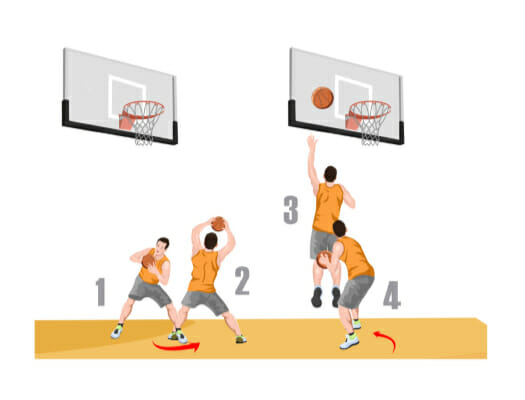
    11. Dribble, Pivot and Shoot

    Attack with the dribble.

    Come to a controlled stop.

    Use a reverse pivot to create space.

    Finish with a shot.

    12. Backdoor Cut and Bounce Pass

    The offensive player makes a backdoor cut.

    The passer first uses a pass fake high.

    Then deliver a bounce pass toward the basket.

    Add Your Own Actions

    These are only examples.

    The drill can be modified almost endlessly.

    You can incorporate:

    • flare screens,
    • curls,
    • handoffs,
    • pin-downs,
    • post-ups,
    • pick-and-roll reads,
    • closeout attacks,
    • relocation threes,
    • cuts,
    • or actions taken directly from your team’s offense.

    The coach’s imagination is the main limitation.

    Why the Drill Works

    The value of the Shoot and Move Drill is that players rarely stand still.

    They must continuously:

    • move,
    • catch,
    • turn,
    • make decisions,
    • execute footwork,
    • pass,
    • rebound,
    • and finish.

    That makes the drill more game-like than stationary shooting alone.

    It can also be used to combine technical development with conditioning.

    From Technique to Game Action

    Shooting practice becomes more valuable when the shot is connected to the movement that creates it.

    Instead of simply asking players to make repetitions, teach them to arrive at the shot through realistic basketball actions.

    Move.

    Receive.

    Read.

    Attack.

    Finish.

    Then move again.
  • Basketball Players Need Strength Training Too

    Basketball Players Need Strength Training Too

    Try it — and let us know what results you achieve.

    Strength Training for Basketball Players

    We strongly believe that basketball players need strength training.

    Work in the weight room can have a direct impact on performance on the basketball court.

    As players become stronger, they may be better prepared to:

    • attack the basket aggressively,
    • compete for rebounds,
    • absorb physical contact,
    • and defend with greater physicality.

    The purpose of this basketball-specific strength program is to help players become stronger while maintaining mobility and flexibility.

    The program was designed as a demanding, full-body training routine.

    The work done in the weight room should ultimately have one purpose:

    to help the player perform better on the basketball court.

    Basic Principles of Weight Training

    1. Train two or three times per week, preferably on non-consecutive days.
    2. Perform every repetition with correct technique.
    3. Once correct technique has been learned, progressively use greater resistance as appropriate.
    4. Rest approximately one minute between sets.
    5. Try to increase the resistance progressively as training experience develops.
    6. Keep a training diary so that progress can be monitored and the work remains structured.

    Three-Day Full-Body Program

    A possible weekly schedule is:

    Monday – Wednesday – Friday

    or:

    Tuesday – Thursday – Saturday

    The original program contains two different exercise routines. These can be alternated within the weekly schedule.

    Workout A

    1. Abdominal Exercises

    Examples:

    • oblique sit-ups,
    • hanging leg raises.

    The objective is to strengthen the trunk and provide a stable base for basketball movement.

    2. Bench Press

    10 – 8 – 6 – 4 repetitions

    Use controlled technique throughout the movement.

    3. Lat Pulldown

    3 × 10

    Develop the muscles of the upper back.

    4. Biceps Exercise

    3 × 10

    5. Triceps Cable Pushdown

    3 sets to the prescribed limit in the original program

    6. Squat / Leg Press

    12 – 10 – 8 – 6 repetitions

    Lower-body strength is particularly important for:

    • jumping,
    • rebounding,
    • acceleration,
    • defensive movement,
    • and playing through contact.

    7. Supported Leg Raises

    10 – 8 – 6 repetitions

    8. Calf Raises

    3 × 30

    9. Wrist Curls

    3 × 25

    Grip and forearm strength can also contribute to stronger ball control and physical play.

    Workout B

    1. Abdominal Exercises

    Examples:

    • sit-up with leg raise,
    • side sit-up,
    • abdominal crunch.

    2. Decline Bench Press

    10 – 8 – 6 repetitions

    3. Seated Row

    3 × 10

    4. Lateral Raises

    10 – 8 – 6 repetitions

    5. Dips

    3 × 10

    6. Dumbbell Biceps Exercise

    3 × 10

    7. Squat / Leg Press

    12 – 10 – 8 – 6 repetitions

    8. Behind-the-Neck Pulldown

    10 – 8 – 6 repetitions

    This exercise appears in the original program and reflects the training practices of the period.

    9. Calf Raises

    3 × 30

    Strength Should Serve Basketball

    Strength training should not be separated from the demands of the sport.

    The objective is not simply to become bigger or to lift heavier weights.

    For a basketball player, strength should support actions such as:

    • finishing through contact,
    • holding defensive position,
    • boxing out,
    • rebounding,
    • accelerating,
    • changing direction,
    • and competing physically throughout the game.

    The strongest player in the weight room is not automatically the best basketball player.

    The real value of strength appears when it can be transferred to the court.

    Technique Comes First

    One principle from the program remains especially important:

    Every repetition should be performed with correct technique.

    Increasing resistance has value only when the movement can still be executed properly.

    Progress should therefore be gradual.

    Training should be recorded.

    Performance should be evaluated.

    And the work should always remain connected to the athlete’s basketball development.

    Strength is not the goal by itself.

    Better basketball performance is the goal.

  • Jump Higher

    Jump Higher

    Everyone wants to jump higher.

    If you are not satisfied with your explosiveness and vertical jump, this program offers a progressive series of exercises that can be adapted from a basic level toward more demanding training.

    The original program is organized into three levels:

    • Basic
    • Intermediate
    • Hard

    The workload gradually increases as the athlete becomes more prepared.

    Training Progression

    The program uses several training days during the week, with recovery days between the main jumping sessions.

    The general progression is:

    Basic Phase

    Begin with lower training frequency and basic jumping exercises.

    The purpose is to become familiar with the movements and build the physical foundation required for more demanding work.

    Intermediate Phase

    Training frequency and exercise difficulty gradually increase.

    The athlete performs more sets and begins using more demanding explosive movements.

    Hard Phase

    The final phase contains the highest training load.

    The emphasis is on maximum effort, explosive execution and more advanced jumping tasks.

    A test can be used at the end of the program to evaluate progress.

    Exercises

    1. Tuck Jumps Without Arm Swing

    Jump vertically without using the arms for momentum.

    Bring the knees toward the chest during the jump.

    Intermediate

    • 1 set
    • 10 repetitions

    Hard

    • 2 sets
    • 10 repetitions

    The emphasis should be on explosive take-off and controlled landing.

    2. Jumps Over an Obstacle

    Jump back and forth over an object approximately 20–60 cm high.

    Basic

    • 1 set
    • 15 repetitions

    Intermediate

    • 2 sets
    • 15 repetitions

    Hard

    • 3 sets
    • 15 repetitions

    The height of the obstacle should match the athlete’s current ability.

    3. Alternating Jumps from a Squat-Support Position

    Perform alternating explosive jumps from a low position.

    Intermediate

    • 1 set
    • 30 seconds

    Hard

    • 1 set
    • 30 seconds

    Maintain control while trying to perform the movement dynamically.

    4. Two-Leg Jumps with Heel Lift

    Jump from both legs while actively using the lower leg.

    Land with the knees flexed.

    Basic

    • 2 sets
    • 15 repetitions

    The landing position is important.

    Absorb the impact rather than landing with stiff legs.

    5. Alternating-Leg Jumps

    Perform continuous alternating-leg jumps.

    Aim for maximum effort.

    Basic

    • 1 set
    • 30 seconds

    Intermediate

    • 1 set
    • 30 seconds

    Hard

    • 2 sets
    • 30 seconds

    The goal is to remain explosive throughout the work period.

    6. Maximum One-Leg Jumps

    Jump as high as possible from one leg.

    Use the opposite knee and the arms aggressively to assist the movement.

    Basic

    • 1 set
    • 30 seconds

    Intermediate

    • 2 sets
    • 30 seconds

    Hard

    • 2 sets
    • 30 seconds

    Both legs should receive appropriate training.

    7. Touch the Rim

    Jump and try to touch the basketball rim — or another appropriately challenging target.

    Basic

    • 2 sets
    • 10 repetitions

    Intermediate

    • 1 set
    • 10 repetitions

    The objective is to make every repetition an explosive attempt rather than simply completing the required number of jumps.

    8. Ankle Jumps

    Perform powerful repeated jumps primarily through the ankles.

    Basic

    • 3 sets
    • 20 repetitions

    The movement should be quick and elastic.

    9. Progressive Running

    Accelerate gradually from approximately 75% effort to 100%, then reduce the intensity again.

    Basic

    • 1 set × 5 repetitions

    Intermediate

    • 2 sets × 5 repetitions

    Hard

    • 3 sets × 5 repetitions

    The objective is controlled acceleration rather than immediately sprinting at maximum speed.

    10. Backward Medicine-Ball Throw

    Use a 3 kg medicine ball.

    Throw the ball backward explosively.

    Basic

    • 1 set × 10 repetitions

    Intermediate

    • 2 sets × 10 repetitions

    Hard

    • 3 sets × 10 repetitions

    This exercise develops explosive force through the lower body, trunk and upper body.

    The Main Principle

    Jumping ability is not improved by simply performing as many jumps as possible.

    The quality of each repetition matters.

    The athlete should aim for:

    • explosive take-off,
    • controlled landing,
    • full effort,
    • proper recovery,
    • and gradual progression from easier to more demanding work.

    The purpose of the program is not simply to become tired.

    The purpose is to become more explosive.

    Train progressively, execute every jump with purpose, and use testing to see whether the work is actually producing improvement.

  • Pre-Competition Training Program

    Pre-Competition Training Program

    The purpose of these guidelines is to encourage coaches to think carefully about the most important principles of training before a major competition.

    One of the fundamental considerations is that the opponent’s known strengths and weaknesses are just as important as our own.

    The training program should therefore reflect both:

    • what our team does well,
    • what still needs improvement,
    • and what the upcoming opponents are likely to demand from us.

    Key Principles

    A pre-competition training program should include:

    • a structured shooting program,
    • fundamental defensive techniques,
    • offensive transition,
    • fast-break situations,
    • attacking an unorganized defense,
    • controlled isolation,
    • structured half-court offense,
    • and transition from offense to defense.

    Defensive fundamentals should first be practiced technically, then under increasingly realistic pressure.

    For example, a defensive task can eventually be maintained for approximately 30 seconds in 3-on-3 or 4-on-4 situations.

    1. Start Every Practice with High-Energy Work

    Every practice should begin with dynamic, high-tempo activities.

    However, progression remains essential.

    One possible approach is to use approximately five three-minute blocks.

    Examples include:

    Three-Ball Transition Drill

    Start from the baseline in pairs using three balls.

    • dribble to half court,
    • make one pass,
    • continue with the dribble,
    • finish with a layup.

    Variation with a Paint Finish

    Use the same structure, but finish with a shot from inside the paint.

    Rebound and Outlet Sequence

    One player begins near the baseline and sideline in an outlet position.

    The player with the ball:

    • self-passes the ball off the backboard,
    • rebounds,
    • takes one dribble,
    • and makes the outlet pass.

    The drill continues in a continuous rotation.

    Continuous Footwork

    Include a continuous footwork exercise emphasizing:

    • balance,
    • speed,
    • coordination,
    • and defensive movement.

    Free Throws Under Fatigue

    Shoot free throws in sets of three immediately after physical loading.

    The objective is to reproduce the physical state in which free throws often occur during games.

    2. Practice Advantage Situations

    Include two or three full-court drills emphasizing numerical advantages.

    Each can last approximately 4–5 minutes.

    These situations should teach players to recognize and exploit advantages quickly.

    Press-break concepts can also be practiced without defenders first so that spacing, timing and movement become automatic before pressure is added.

    3. Defensive Fundamentals

    Fundamental defensive exercises should remain part of the program.

    At the same time, offensive players should execute technically correct actions so that both sides of the drill improve.

    Use two or three foundational exercises and then build them gradually toward:

    • small-sided team situations,
    • and eventually 5-on-5.

    Examples include:

    Defending the Ball Handler

    Practice containment and influencing the direction of the dribbler.

    This can be done:

    • full court,
    • in court segments,
    • from half court,
    • from specific positions,
    • with a layup finish,
    • or with a jump-shot finish.

    Boxing Out

    For example, the coach takes the shot.

    Players execute the box-out and then continue immediately into full-court 1-on-1.

    Denying Cuts

    Practice defending offensive cuts in 2-on-2 situations.

    Correct Help Defense

    Use 2-on-2 situations to reinforce proper help positioning and recovery.

    4. Build from Small-Sided Situations

    In small-sided team situations, approximately the first two-thirds of the action can be predetermined.

    The final part should then allow players to finish creatively.

    This structure gives the coach control over the tactical objective while still requiring the players to:

    • read the defense,
    • make decisions,
    • and create solutions.

    5. Basketball-Specific Conditioning

    Conditioning should also take place on the basketball court.

    Use 1–3 minute blocks involving basketball-specific activities such as:

    • defensive work,
    • agility,
    • shooting,
    • rebounding,
    • and transition.

    The exercises can be organized:

    • as a team,
    • in pairs,
    • or in groups of three.

    The objective is to condition the players through movements and decisions that resemble the game.

    6. Practice the Offensive Style

    The team should rehearse its offensive identity and transition game.

    Against a set defense, practice situations such as:

    Quick Offense into Longer Possessions

    Players must understand when to attack immediately and when to continue into a longer half-court possession.

    Inbound Plays

    Practice sideline and baseline situations that may become important in close games.

    Situations Following Free Throws

    Players should know their responsibilities immediately after both made and missed free throws.

    Cutting Actions

    Rehearse offensive actions based on purposeful cutting and coordinated movement.

    Finishing Situations

    Practice possessions that finish through:

    • 1-on-1 creation,
    • or interior passing and post play.

    7. Finish with 5-on-5

    The practice should ultimately progress toward 5-on-5.

    Before each block, clearly define:

    • the offensive objective,
    • and the defensive objective.

    The coach should avoid stopping play too frequently.

    Only major mistakes should interrupt the action.

    Players need extended periods in which they can:

    • read situations,
    • solve problems,
    • communicate,
    • and maintain continuity.

    Players resting outside the 5-on-5 action can perform upper-body and trunk-strengthening exercises.

    At the end of practice, include approximately 3–5 minutes of jump rope.

    Jump rope can also be used earlier in practice as part of the warm-up.

    Build Each Practice on the Previous One

    The next practice should always build on what was done before.

    However, training should continue to progress.

    A useful guideline is that approximately 70% of the practice should move the team forward.

    Only the most important elements should be repeated extensively.

    The objective before a major competition is not simply to rehearse everything the team already knows.

    The objective is to sharpen the elements that will matter most.

    Training should therefore become increasingly:

    • specific,
    • purposeful,
    • game-like,
    • intense,
    • and connected to the demands of the upcoming opponent.

    The closer the competition becomes, the clearer the priorities should be.

  • Keys to Effective Full-Court Pressure

    Keys to Effective Full-Court Pressure

    Practical advice on pressing defense from the head coach of Metro State University in Denver.

    • When the offense breaks your press, the defense must remain just as solid and aggressive.
    • If you want to become a pressing team, your entire program has to be built around that mentality.
    • One of the greatest advantages for a pressing team is simply making shots. Scoring gives you more opportunities to organize and vary your pressure defense.
    • The goal of the defense should be to become disruptive.

    Step by Step

    Take the Primary Ball Handler Out of the Game

    One of the first objectives of the press should be to disrupt or remove the opponent’s primary ball handler from his usual role.

    Make someone else organize the offense.

    You Have to Be in Excellent Condition

    Pressing requires conditioning.

    The press may not immediately produce a steal, but the reward can appear later in the game as the opponent becomes increasingly tired and uncomfortable.

    Control the Tempo

    Use pressure to influence the rhythm of the game.

    Sometimes you want to speed the opponent up.

    At other times, you may want to slow them down and prevent them from comfortably entering their offense.

    Force Turnovers

    The defense should actively create mistakes.

    Do not simply wait for the offense to make one.

    Force Poor Shots

    Pressure should encourage the opponent to take:

    • rushed shots,
    • quick shots,
    • poorly prepared shots,
    • and shots outside the normal offensive rhythm.

    Pressing Is About Effort

    An effective press is not primarily about athletic ability.

    It is about effort.

    That effort has to be consistent if the defense is going to work.

    Transition into the Press

    Your team must be excellent at changing from offense to defense.

    Players have to take their positions quickly.

    The press cannot begin late.

    The first few seconds after possession changes are critical.

    Forget Your Matchup When You Trap

    When a trap is initiated, players must stop thinking only about their individual matchup.

    The team has to rotate.

    Once two defenders commit to the ball, the remaining defenders must understand the resulting responsibilities.

    Pressing and Trapping Are Not the Same Thing

    Players need to understand the difference between a pressing defense and a trapping defense.

    Not every press has to produce a trap.

    And not every trap has to occur within a full-court press.

    The purpose, timing and rotations are different.

    The “NOW!” Call

    Whenever the ball is passed to a center or another interior player in the backcourt or far away from your own basket, the entire team should immediately communicate:

    “NOW!”

    This becomes an emergency signal.

    It tells everyone that the defense has an opportunity to increase pressure.

    From that moment, your own assignment must not receive an easy pass.

    The whole team has to react together.

    Let the Big Players Experience the Front of the Press

    Occasionally place your interior players at the front of the press.

    This allows them to experience how much effort perimeter players normally have to produce at the top of the defense.

    It can improve understanding and appreciation of each player’s role within the system.

    Sometimes the Press Is Only There to Slow the Game

    A press does not always need to be extremely aggressive.

    Sometimes its purpose is simply to slow the opponent down.

    In those situations, there may be no need to trap.

    The objective may simply be to reduce the time available for the opponent to organize the offense.

    Your Centers Must Direct the Defense

    Interior players must communicate extremely well from the back of the press.

    They can see almost everything in front of them.

    For that reason, they have a major responsibility for organizing and directing the defense.

    An effective full-court press is therefore not simply five players running aggressively after the ball.

    It requires:

    • effort,
    • conditioning,
    • communication,
    • clear responsibilities,
    • intelligent trapping,
    • coordinated rotations,
    • and a shared defensive mentality.