Szerző: BasketClinic

  • Hungarian Coaches’ Day 🇭🇺🏀

    Hungarian Coaches’ Day 🇭🇺🏀

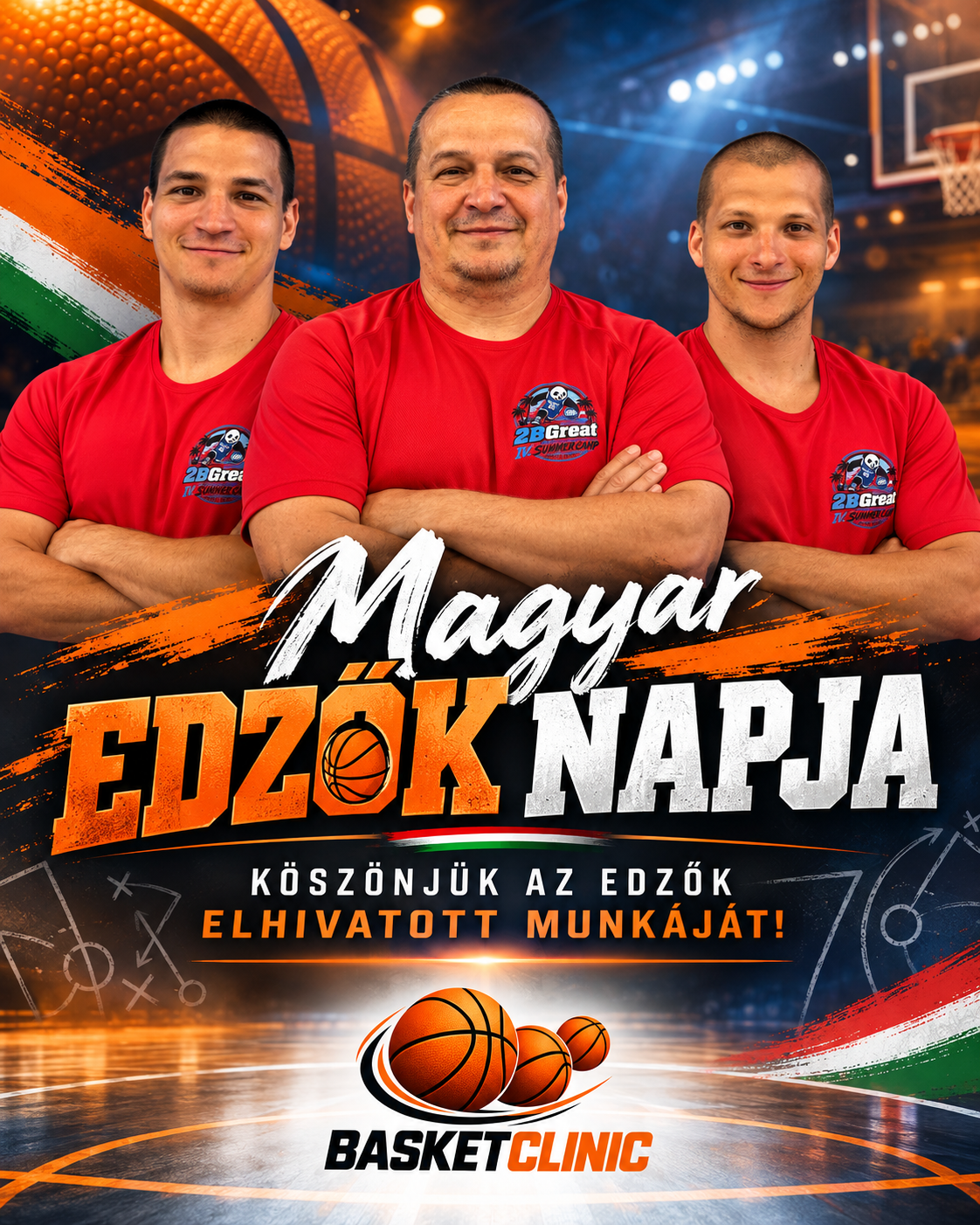
    Today, we celebrate the coaches who teach, motivate, inspire, and help shape not only athletes, but people.

    Coaching is much more than what happens during practices and games. It requires knowledge, responsibility, patience, continuous learning, and above all, a genuine commitment to players and the sport.

    On Hungarian Coaches’ Day, we would like to thank every coach for the countless hours, energy, passion, and dedication they invest in developing the next generation.

    Happy Hungarian Coaches’ Day! 🏀🇭🇺

  • New Publication: What Career Paths Lead to an NBA Head Coaching Position?

    New Publication: What Career Paths Lead to an NBA Head Coaching Position?

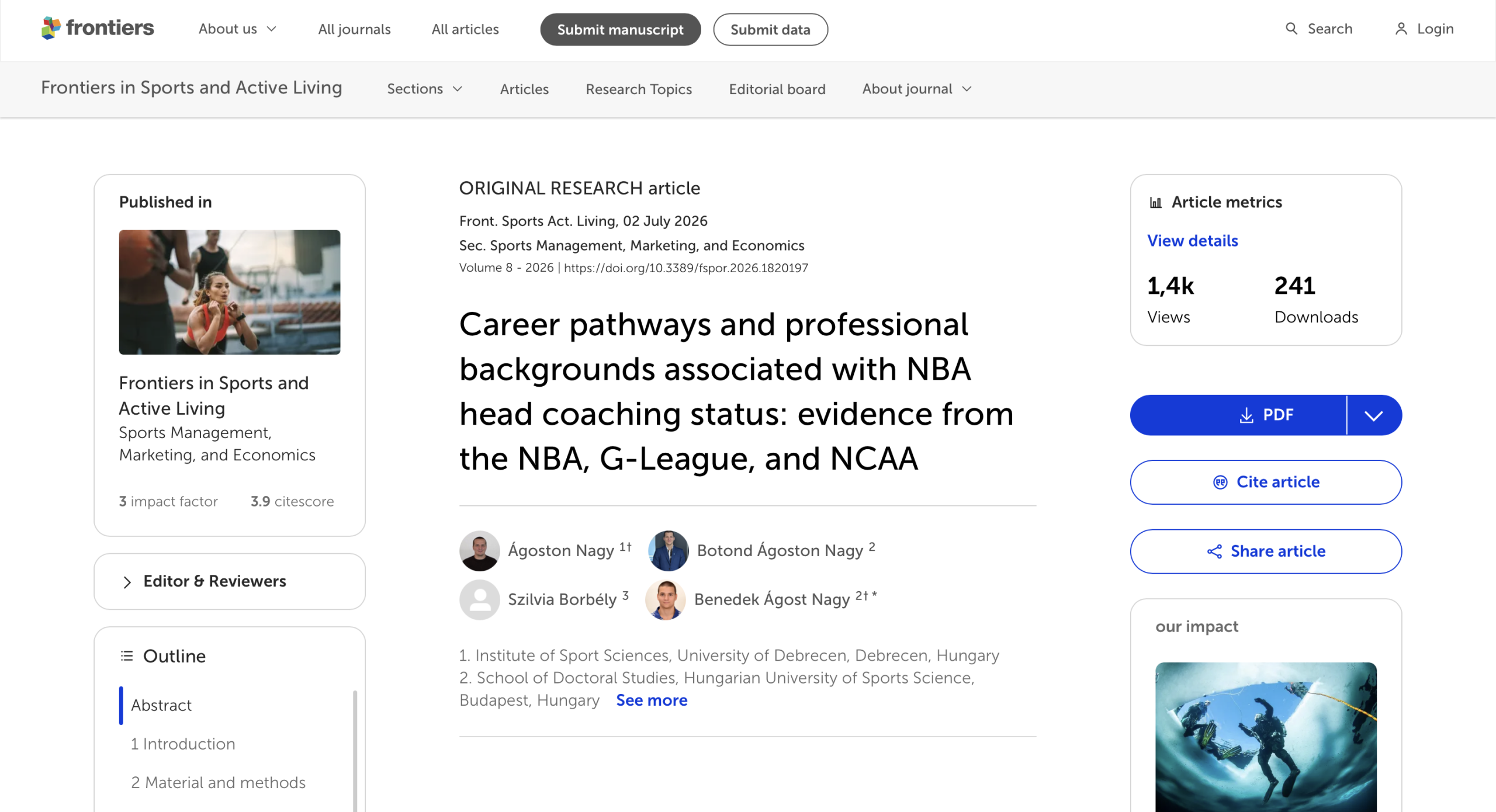
    We are pleased to share our new research article published in Frontiers in Sports and Active Living:

    Career pathways and professional backgrounds associated with NBA head coaching status: evidence from the NBA, G-League, and NCAA

    The study was authored by Ágoston Nagy, Botond Ágoston Nagy, Szilvia Borbély and Benedek Ágost Nagy and examines one of the most interesting questions in professional basketball coaching:

    What professional experiences are associated with reaching an NBA head coaching position?

    Comparing Three Coaching Environments

    The study analyzed the professional backgrounds of 76 head coaches:

    • 30 NBA head coaches,
    • 30 randomly selected NCAA Division I head coaches,
    • and 16 NBA G-League head coaches.

    The analysis included demographic characteristics, playing experience and coaching-career variables in order to identify which factors were most strongly associated with NBA head coaching status.

    NBA Experience Matters

    The clearest result concerned previous experience as an NBA assistant coach.

    Among the NBA head coaches in the sample, 83.3% had previously worked as NBA assistant coaches, compared with 37.5% of G-League head coaches and 16.7% of NCAA Division I head coaches.

    In the final statistical model, previous NBA assistant coaching experience showed the strongest independent association with NBA head coaching status.

    NBA playing experience was also significantly associated with becoming an NBA head coach, although the relationship was weaker than that observed for assistant coaching experience.

    Professional Embeddedness Over Demographics

    One of the most important messages of the study is that advancement toward an NBA head coaching position appears to be associated more strongly with NBA-specific professional experience and organizational exposure than with demographic characteristics alone.

    Age was not a statistically significant predictor in the final model.

    The same was true for White race/ethnicity.

    Formal educational background also appeared less important than direct professional experience within elite basketball organizations.

    Playing Experience Helps — But It Is Not Enough

    Having played in the NBA may provide future coaches with valuable experience of:

    • elite competition,
    • player relationships,
    • team dynamics,
    • pressure,
    • and the organizational demands of professional basketball.

    However, the results suggest that playing experience alone does not define the pathway toward becoming an NBA head coach.

    The transition into coaching roles — and particularly gaining experience inside an NBA coaching staff — appears to be especially important.

    Coaching Careers Are Built Step by Step

    There is no single route to the top.

    Coaches may begin their professional development as:

    • players,
    • video analysts,
    • player-development coaches,
    • assistant coaches,
    • G-League coaches,
    • or college coaches.

    Over time, they accumulate experience through competition, mentoring, professional relationships and different organizational roles.

    The results of this study reinforce the idea that elite coaching development is a long-term professional process rather than a single qualification or career event.

    Why Does This Matter?

    Understanding coaching pathways can help:

    • aspiring coaches plan their professional development,
    • organizations better understand coaching-career structures,
    • coach-education programs identify relevant experiences,
    • and researchers explore how elite coaches develop over time.

    The findings also suggest that access to professional environments and meaningful coaching roles may be particularly important for career progression.

    Importantly, these findings describe associations rather than causal effects. Becoming an NBA assistant coach does not automatically lead to an NBA head coaching position, but within this sample, NBA-specific coaching experience was clearly associated with reaching that level.

    Publication Details

    Nagy Á, Nagy BÁ, Borbély S and Nagy BÁ (2026).
    Career pathways and professional backgrounds associated with NBA head coaching status: evidence from the NBA, G-League, and NCAA.

    Frontiers in Sports and Active Living, Volume 8.

    DOI: 10.3389/fspor.2026.1820197

    Published: July 2, 2026

  • New Publication: Offensive Efficiency and Traditional Positional Roles in Hungarian Basketball

    New Publication: Offensive Efficiency and Traditional Positional Roles in Hungarian Basketball

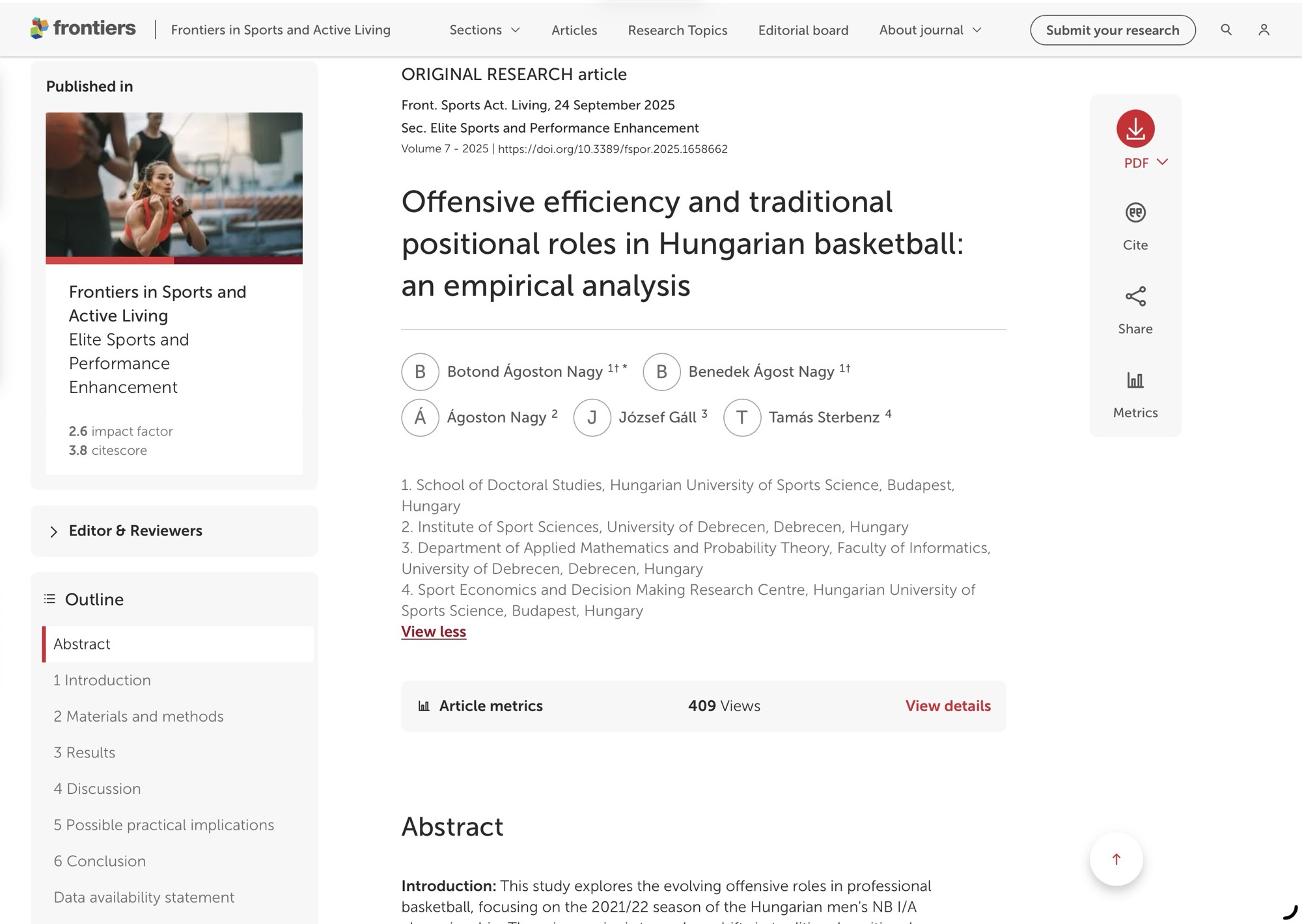
    I am delighted to announce the publication of our latest scientific article in Frontiers in Sports and Active Living, written in collaboration with my co-authors, Benedek Ágost Nagy, Ágoston Nagy, József Gáll, and Tamás Sterbenz.

    📄 Title:

    “Offensive Efficiency and Traditional Positional Roles in Hungarian Basketball: An Empirical Analysis”

    🔗 Full article available here: Frontiers – Article link

    About the study

    This research explores the evolving offensive roles in professional basketball, focusing on the 2021/22 Hungarian NB I/A season. We analyzed 239 player profiles, grouped into imports, Hungarian-educated, and U23 players, using 17 offensive efficiency indicators (points, shooting percentages, usage, OffRtg, NetRtg, assist-to-turnover ratio, etc.).

    Key findings

    Inside positions excelled: Centers and power forwards (positions 4–5) showed higher shooting efficiency compared to perimeter positions. Imports led the way: Foreign players consistently outperformed in scoring, efficiency, and usage. Domestic contributions: Hungarian and U23 players took on important decision-making roles (assists, steals vs. turnovers), showing developmental potential. Youth challenges: U23 players produced lower efficiency but gained valuable experience thanks to mandatory playing time.

    Why it matters

    The study highlights the ongoing transformation of basketball roles beyond the rigid five traditional positions. For Hungarian basketball, the results underline the importance of investing in talent identification and development, ensuring that domestic players are not only present but effective contributors in key offensive situations.

    By focusing on flexible roles, efficient scoring, and decision-making, Hungarian teams can improve both competitiveness and sustainability at the professional level.

  • New Publication: Rethinking the Strongest Link

    New Publication: Rethinking the Strongest Link

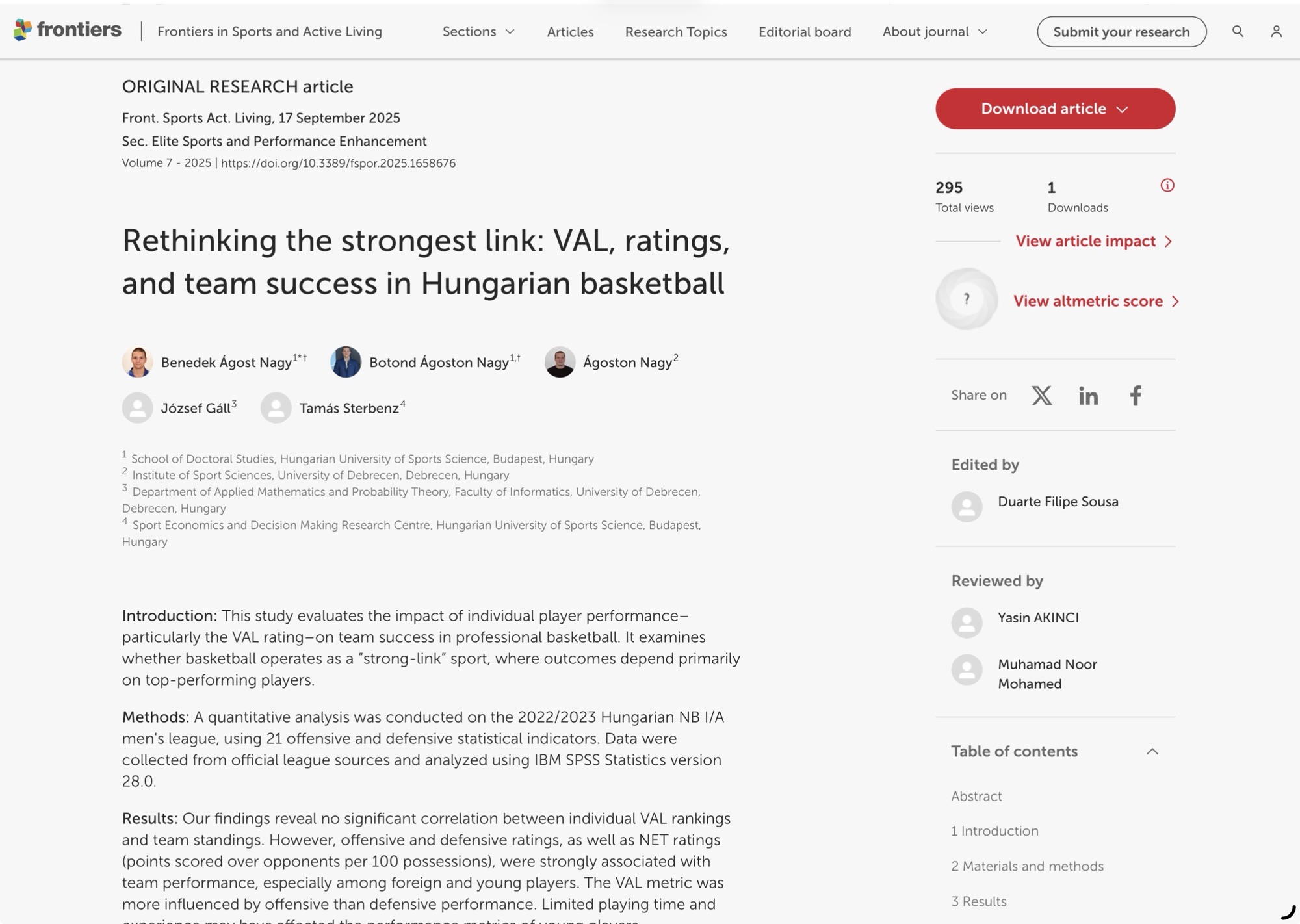
    I am delighted to announce the publication of our latest scientific article in Frontiers in Sports and Active Living, written in collaboration with my co-authors, Benedek Ágost Nagy, Ágoston Nagy, József Gáll and Tamás Sterbenz.

    📄 Title:

    “Rethinking the Strongest Link: VAL, Ratings, and Team Success in Hungarian Basketball”

    🔗 Full text available here: Frontiers – Article link

    About the study

    The research explores whether Hungarian basketball truly operates as a “strong-link” sport, where outcomes depend on top performers, and how well traditional metrics like VAL capture a player’s real impact on team success. Using detailed data from the 2022/23 NB I/A season, we examined 137 players across three categories: imports, Hungarian-educated, and U23 players.

    We analyzed 21 offensive and defensive indicators (including points, shooting percentages, rebounds, assists, turnovers, and advanced ratings like OffRtg, DefRtg, and NetRtg) to understand which measures are most strongly linked to team results.

    Key findings

    VAL is limited: It does not strongly correlate with team standings, and it reflects offensive contributions more than defensive ones. Ratings matter more: Offensive Rating, Defensive Rating, and especially Net Rating showed strong associations with team success. Group differences: Foreign players had the highest performance values, Hungarians were the most balanced, while youth players showed the widest variability. Trends: Mid-range shots continue to decline, while free throws, close-range, and three-point shooting efficiency remain decisive. Practical insight: Coaches should focus on free-throw accuracy, defensive rebounding (especially for youth), and balanced player development rather than relying solely on MVP-type performances.

    Why this matters

    The study demonstrates that team balance and efficiency metrics are more reliable indicators of success than individual star-value rankings. This has significant implications for coaches, player development, and roster building in Hungarian basketball and beyond.

    This publication is an important milestone in my doctoral research, advancing both the academic study of basketball and the visibility of Hungarian basketball on the international stage.

  • More Stories from the Basket Clinic Archive

    More Stories from the Basket Clinic Archive

    The Basket Clinic archive continues to grow.

    As part of the renewal of Basketclinic.hu, another collection of earlier articles has now been restored and republished in English.

    These posts originally appeared on the former Basket Clinic platforms over several years and form an important part of the history of the website.

    More Than Coaching Articles

    Basket Clinic has never been only about drills, tactics or training methods.

    Basketball has always been connected to something larger.

    The newly restored archive therefore includes not only professional coaching material, but also:

    • personal stories,
    • memories from basketball life,
    • reflections on coaching,
    • stories about players and teams,
    • tributes and memorials,
    • thoughts about motivation and success,
    • and moments in which basketball became part of family and everyday life.

    Some of these articles were written more than a decade ago.

    They capture a particular moment, a particular team, a particular person or simply a feeling that seemed worth preserving.

    Published in Their Historical Context

    These articles should be read as archival material.

    The dates shown on the posts refer to their original publication dates.

    They have not been rewritten to make them appear as if they were created today.

    Instead, the Hungarian originals have been translated into English and edited for clarity while preserving their original meaning, tone and historical context.

    Where an article reflects the basketball environment, technology, competition structure or thinking of its time, that context remains part of the story.

    Preserving the Personal Side of Basket Clinic

    One of the most valuable parts of an archive is that it preserves more than information.

    It preserves people.

    Teams.

    Places.

    Relationships.

    Victories and defeats.

    Moments that seemed ordinary at the time but gradually became part of a much larger story.

    The restored articles include memories connected to youth basketball, DEAC, the University of Physical Education, Hungarian basketball and international figures who influenced the way we understood the game.

    Together, they show how basketball became intertwined with coaching, education, family, friendship and personal identity.

    Why Keep These Articles?

    Because history is not made only from championships, statistics and official records.

    It is also made from:

    • practices nobody else remembers,
    • conversations after games,
    • players growing into adults,
    • coaches becoming friends,
    • traditions passed from one generation to another,
    • and small moments that remain important many years later.

    These articles help preserve that part of basketball history.

    And perhaps some of the thoughts written years ago can still give something to players, coaches and readers today.

    The Archive Continues

    More historical Basket Clinic material may continue to appear as the archive is reviewed and restored.

    Whenever possible, the original:

    • publication date,
    • author,
    • source,
    • translator,
    • and historical attribution

    will remain visible.

    The purpose is simple:

    to preserve where Basket Clinic came from while continuing to build where it is going.

    The past remains part of the site.

    Not as something frozen in time, but as the foundation on which the next chapter can be built.

  • A World Without Kobe

    A World Without Kobe

    Budapest, January 28, 2020

    For three days, I have been quiet.

    I have been trying to accept something I know will not be easy to accept — something that makes me feel as if I will never be entirely whole again.

    A part of me had already died when Kobe stopped playing and we knew there was no way back.

    For our family, basketball has never been simply a pastime.

    It has become one of the central themes of our everyday lives.

    Because of that, we do not have to search for the people and things that complete our lives. Somehow, we are naturally drawn toward them.

    Toward what makes life more beautiful.

    Toward what makes us better.

    We found that in the game — and in the sacrifice and work required to pursue it.

    From Jordan to Kobe

    Michael Jordan developed as a player in a way that established a standard for all time.

    Eventually, that era had to end.

    That is the natural order of things.

    But fortunately, Kobe was there.

    In many ways, he continued from exactly where the very best had stopped.

    With Kobe, we were able to experience that same process of development again.

    And as technology advanced, he somehow became increasingly close to us.

    Without exaggeration, Kobe gradually became part of our everyday lives almost like a member of the family.

    At practice, we would often mention both Jordan and Kobe.

    Certain movements were measured against them.

    Certain standards were explained through them.

    The benchmark they established for basketball players around the world became part of our own thinking as well.

    They are always somewhere in our minds.

    Perfection.

    Humility.

    The desire to win.

    Persistence.

    Passion.

    These values made what they represented impossible to ignore.

    Only One Day Earlier

    On January 25, we watched Jordan’s press conference in Paris live.

    Then we watched Kobe embrace LeBron after LeBron had passed him on the all-time scoring list.

    A thought crossed my mind:

    how fortunate I was to have seen them play.

    To have experienced their greatness.

    A greatness that still permeates basketball and the lives of athletes around the world.

    On Friday, before leaving home, I walked over to the bookshelf and pulled out The Mamba Mentality for a moment.

    I even ran my hand across the cover.

    It is a beautiful edition, slightly embossed so that you can almost feel the book rather than simply read it.

    Then I checked the latest news on my phone.

    And of course, among the first things I saw were Kobe and several new videos and posts about him.

    Two days later, while travelling, we received the incomprehensible news.

    At first, we simply hoped it was not true.

    Then confirmation began arriving minute by minute.

    And with every new confirmation came more tears.

    Even now, I cannot stop them.

    That is what his absence means.

    Pain.

    As if someone from the family had gone.

    More Than a Player

    I know we had not seen him on the court for some time.

    But he had created a world beyond playing basketball — a world that continued to reinforce what we ourselves believe in and live for.

    We all learn.

    We mature.

    We search for ways to contribute something meaningful to our existence.

    Perhaps nowhere more than in sport do we find individuals who can provide examples that people genuinely try to follow.

    There are athletes we support.

    There are others with whom we identify.

    And there are some to whom, in a figurative sense, we feel that we somehow belong.

    Not everyone will completely understand what Kobe represented.

    Perhaps you have to try walking some distance along the path he showed us before you can truly understand it.

    We cannot see everything about another person’s life.

    And even if we could, perhaps we would not find perfection.

    But what Kobe represented week after week was not hypocrisy or empty talk.

    It was a direction.

    Something that has to be understood as a whole.

    Away from the Court

    That is why it was such a gift to see that the person we watched on the court also existed beyond it.

    A father who adored his children.

    Perhaps it could not have been any other way.

    That was who he was.

    Sport had taught him how to love.

    And then there was that little girl who had been beside him so often during those final months.

    She had almost become familiar to us too.

    There are no words for the pain of losing her.

    I almost feel it myself.

    For two days, I have been watching the videos and feeling that something inside me has broken because of her as well.

    The Void

    We have already lost many people from the basketball community.

    For many of them, we have said that they left too soon.

    Unexpectedly.

    Inexplicably.

    And those of us who remain are left with our questions and our feelings.

    The loss of Kobe leaves a global emptiness.

    Everyone who knew what he represented will carry some trace of it for the rest of their lives.

    At the same time, that loss connects us.

    He helped create a shared language.

    A language with words that will continue to represent permanence.

    And with signs, gestures and movements that will continue to mean the same things.

    It feels good to belong to the people who understand what I mean.

    What Remains

    I hope the values that became part of our shared knowledge through the Kobe legend will now show even more young people a direction.

    I am deeply grateful that Kobe meant the same thing to my children and to the people around me.

    His death has created a new meaning for us as well.

    From now on, we will finish every practice by shouting his name.

    Because that name contains almost everything for which we play basketball.

    And because:

    “…those who are remembered through their deeds become immortal.”

    That is not the only thing we can do with the legacy he left behind.

    But perhaps even this small ritual can help us continue something of what Kobe Bryant represented to the world.

    A world in which we now have to learn to live without him.

    And slowly, very slowly, the tears will begin to dry.

    Dr. Ágoston Nagy
    Budapest, January 28, 2020