
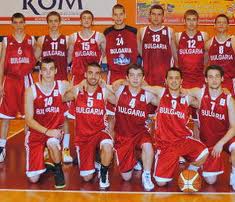
The winning Bulgarian team pictured above.
We took a closer look at the qualities and characteristics that were required this year for a team to reach the top four.
The strongest teams shared a surprisingly wide range of common features.
- They were able to defend effectively over the entire court.
- They showed above-average shooting consistency, even under defensive pressure.
- They consciously used tactical fouling when appropriate, considering the time remaining and the depth of the bench. Preventing points after turnovers remained a priority, but defensive effectiveness came before simply avoiding personal fouls.
- Their off-ball movement was faster, more purposeful and technically better executed.
- They used several different ways to involve post players, both dynamically and from static positions.
- They defended ball screens at a very high level.
- They punished open shots consistently.
- They deliberately used inside-outside actions.
- At the beginning of quarters, they looked for reliable ways to score.
- They handled pressure defense with confidence.
Communication was constant.
The best teams showed a clear intention to rebound, organized the rebound collectively and immediately connected it to transition play.
They were also capable of using surprise defensive schemes.
Every successful team had leaders: players who could organize the offense, handle the ball safely, shoot consistently from multiple situations and attack one-on-one to break down almost any defense.
Virtually every player was capable of attacking the basket both in transition and from a stationary position.
They demonstrated technically sound positioning and cutting techniques.
Proper nutrition — both in quality and quantity — also played an important role.
Late-game situations were well organized, including isolations, pick-and-roll and pick-and-pop actions.
Inbound plays were executed reliably.
Mental unity was another major characteristic. There were very few obviously selfish players. Even when such tendencies appeared, players were able to rise above them in high-pressure situations and become leaders for the team.
Unselfishness and team spirit were clearly visible.
Offensive execution was technically strong, with firmer, more accurate passing.
Motion-based offensive systems dominated. The exception was the Montenegrin team, whose offense relied heavily on Serbian-style screening actions.
Teams were comfortable attacking both even-front and odd-front zone defenses.
Many of their man-to-man offensive principles also worked effectively against zone defense.
Legal and physical on-ball and off-ball screens were used regularly.
Cuts were purposeful rather than automatic.
On penetration, players read the defensive rotation and looked for the appropriate shooters according to the situation.
Transition play was extremely well organized in both directions — offense and defense.
Shooting actions were quick and game-like.
In controlled half-court situations, teams used post play, perimeter shooting and isolated one-on-one situations.
Most possessions were played within a motion offense, while more controlled actions were commonly used after inbound plays or following made baskets.
The players also fatigued significantly later.
They were able to maintain concentration for longer periods, although most teams still used rotations of 10–12 players.
Complementary roles worked effectively: bigger and smaller guards, slower and more athletic interior players, and specialists with clearly defined responsibilities.
Every team had defensive specialists capable of guarding specific opponents.
It was obvious that these teams were accustomed to playing together.
Players often understood each other through simple signals, and coaches did not need to call a timeout every time an adjustment was required.
Discipline was clearly visible.
It is also a misconception that high-level teams do not play zone defense. These teams used zone defenses to a significant extent.
Finally, they consistently looked for opportunities to score quickly.
The difference between good teams and the very best was not one single tactical element.
It was the combination of technical quality, decision-making, physical preparation, discipline, communication, role clarity and collective understanding.