
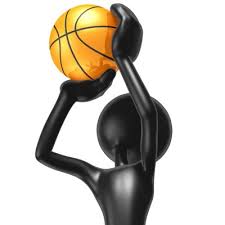
Shooting is an art.
But it is also a logical skill — one that can be learned, practiced and improved.
A basketball shot should be approached in much the same way as aiming at a target. It is a complex movement made up of several interconnected elements. It is certainly not a matter of luck, as many people seem to believe.
There is a huge difference between throwing at a target for fun at an amusement park and taking a free throw in a basketball game.
The first is entertainment and a simple challenge.
On the basketball court, however, making the shot can become a necessity.
Because of this, many different factors influence shooting performance.
Learning the Movement
Successful execution requires several elements to come together.
The stages of motor learning can be described as:
- becoming familiar with the movement and learning the technique,
- learning through repetition,
- applying the skill in real situations.
Beyond technical learning, shooting is also heavily influenced by physical condition.
As fatigue increases, muscular performance begins to decline first. With continued exertion, concentration decreases. Emotional control may then begin to deteriorate, and eventually even sensory performance becomes impaired before complete exhaustion occurs.
For accurate shooting, players therefore need a level of physical conditioning that allows them to delay these effects for as long as possible.
Shooting endurance must be developed through the repetition of correct movements.
The objective should always be greater accuracy together with economical and efficient execution.
The Structure of the Shot
A shot consists of three basic elements:
- preparation,
- aiming,
- the shooting motion itself.
The shooter should eliminate unnecessary movement and direct complete concentration toward the target.
That is exactly what we should try to achieve in basketball.
The objective, of course, is not to hit a target with a weapon, but to score points.
Shooting is also closely connected to a player’s mental state.
A shooter cannot simply assume that the ball will go in.
Distractions must be blocked out.
Calm breathing can help reduce unnecessary muscular tension. Proper oxygen supply can also contribute to maintaining an optimal physical state.
The bones, muscles and joints should work together so that force is directed efficiently in one coordinated direction.
The goal is a comfortable, economical and repeatable movement.
A movement that has been practiced tens of thousands of times.
We shoot when rested.
We shoot after warming up.
We shoot in practice.
We shoot in scrimmages.
We shoot in games.
And sometimes we shoot in emergency situations, when everything depends on a single attempt.
We must be prepared for all of them.
A player should never simply “throw the ball up.”
Every shot should be taken with an understanding of its consequences.
That awareness will influence execution.
Even with perfect preparation, however, the possibility of missing always remains.
In certain situations, one or more of the ideal conditions required for perfect execution may already have been reduced or lost.
The Free Throw
At the free-throw line, the shooter should not be distracted by clothing, other players or unnecessary movements.
Every additional distraction reduces the possibility of perfect execution.
In theory, the free throw offers the closest thing to a 100 percent shooting opportunity because there is no defender directly interfering with the shot.
The main factors are time, the target, the ball and the shooter’s own level of preparation.
Both feet should point forward.
The player should stand approximately shoulder-width apart and, after a few dribbles, settle into the shooting position.
The body should lean slightly forward.
The ball is held in front of the chest.
The wrist supports the ball from behind, while the palm of the shooting hand faces the target.
From this stable aiming position, the ball is raised approximately 30 centimeters above the head.
From there, extension of the elbow provides the upward force and trajectory, while the forward snap of the wrist directs the ball toward the target.
The entire movement begins from a balanced position, with the shoulders parallel to the backboard.
The motion develops through a coordinated kinetic chain:
the body rises onto the toes,
the knees extend,
the hips extend,
the ball moves above the head,
the elbow extends,
and finally the wrist snaps forward.
The mind searches for the correct trajectory, sending the ball just beyond the front of the rim.
When executed perfectly, it can be one of the most beautiful movements in sport.
The Foundation of Every Shot
The free throw also provides the foundation for many other shots taken from the field.
Most of them are closely related to the same basic movement.
There are small differences, of course, because new factors are introduced.
A defender may be present.
Time may be limited.
Movement may precede the shot.
Pressure may increase.
These factors make it even more important to practice shooting repeatedly and deliberately.
But the work is worth it.
A beautifully executed shot can create a feeling that only those who have experienced the perfect movement can truly understand.
Ágoston Nagy
Zánka, August 7, 2004