
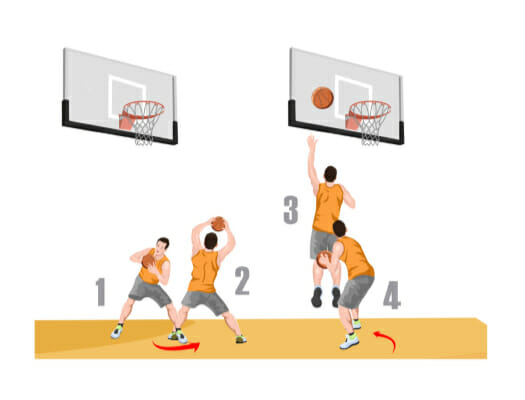
This drill has evolved over the years.
Originally, it was used partly as a shooting drill and partly as a conditioning exercise.
Over time, it developed into a flexible offensive drill that can combine:
- shooting,
- passing,
- catching on the move,
- footwork,
- ball handling,
- finishing,
- screening actions,
- and conditioning.
Basic Organization
Every player works with a partner.
The players begin near the basket with one basketball.
The sequence is simple:
- One player shoots.
- The shooter gets the rebound.
- The rebounder passes to the moving partner.
- The moving player receives the ball while turning toward the basket.
- The drill continues with the players alternating roles.
An important detail is that the receiver should catch the ball cleanly and legally without traveling.
The coach can then determine what action must follow the catch.
Possible Catch-and-Finish Variations
The receiving player can perform different actions.
For example:
- catch and shoot,
- catch, shot fake and shoot,
- catch, shot fake, dribble and shoot,
- catch, shot fake, one dribble, second shot fake and shoot,
- catch, shot fake and finish with a layup,
- catch, shot fake, dribble, stop, shot fake and shoot.
The structure remains the same.
Only the offensive decision changes.
Make It Competitive
The drill can also become a competitive exercise.
Players can compete by:
- made baskets,
- shooting percentage,
- consecutive makes,
- time,
- or completing a required number of successful repetitions.
This adds pressure and increases the intensity of the drill.
Connect It to Your Offense
One of the greatest advantages of the Shoot and Move Drill is its flexibility.
The movements can be adapted to parts of your own offensive system.
The coach can use actions that will appear in the next game or actions that are important within the team’s offensive philosophy.
Instead of practicing movements in isolation, players can rehearse situations they are expected to recognize during competition.
Adjust the Drill by Position
Players can perform different actions depending on their position.
Interior players should generally work within approximately five meters of the basket when practicing post-oriented movements.
Always keep enough players around the baskets to maintain rebounding and passing flow.
The coach can also determine the type of pass used:
- chest pass,
- bounce pass,
- two-handed pass,
- pass off the dribble,
- or another game-specific pass.
Every action should be practiced from both sides of the floor.
Offensive Variations
The following are examples of movements that can be incorporated into the drill.
1. Cross-Lane Drive, Spin and Finish
Dribble across the paint.
Execute a spin move.
Finish with a layup.
2. Baseline Drive, Spin and Finish
Attack toward the baseline.
Use a spin move to create separation.
Finish at the basket.
3. Ball Screen, Dribble and Shot
Use a ball screen.
Come off the screen with the dribble.
Finish with a shot.
4. Screen and Roll
Set the screen and roll toward the basket.
Practice the timing between the ball handler and screener.
5. Pick-and-Roll Pass to the Screener
Use the screen.
Read the defense.
Pass to the rolling screener.
6. Post Movement with a Partner
Work on post positioning and movement.
Deliver the entry pass to the interior player.
7. Post Pass, Cut, Return Pass and Shot
Pass the ball into the post.
Cut away from the original position.
Receive the return pass.
Finish with a shot.
8. Screen, Pop and Shoot
Set the screen.
Instead of rolling toward the basket, move outward into open space.
Receive the pass and shoot.
9. Three-Point Shot
Move into three-point range.
Catch in balance and shoot.
10. 1-on-1 with a Maximum of Two Dribbles
Play live 1-on-1.
The offensive player may use no more than two dribbles.
This forces efficient decision-making.
11. Dribble, Pivot and Shoot
Attack with the dribble.
Come to a controlled stop.
Use a reverse pivot to create space.
Finish with a shot.
12. Backdoor Cut and Bounce Pass
The offensive player makes a backdoor cut.
The passer first uses a pass fake high.
Then deliver a bounce pass toward the basket.
Add Your Own Actions
These are only examples.
The drill can be modified almost endlessly.
You can incorporate:
- flare screens,
- curls,
- handoffs,
- pin-downs,
- post-ups,
- pick-and-roll reads,
- closeout attacks,
- relocation threes,
- cuts,
- or actions taken directly from your team’s offense.
The coach’s imagination is the main limitation.
Why the Drill Works
The value of the Shoot and Move Drill is that players rarely stand still.
They must continuously:
- move,
- catch,
- turn,
- make decisions,
- execute footwork,
- pass,
- rebound,
- and finish.
That makes the drill more game-like than stationary shooting alone.
It can also be used to combine technical development with conditioning.
From Technique to Game Action
Shooting practice becomes more valuable when the shot is connected to the movement that creates it.
Instead of simply asking players to make repetitions, teach them to arrive at the shot through realistic basketball actions.
Move.
Receive.
Read.
Attack.
Finish.
Then move again.