
Címke: return to play

  • Strengthening After Knee Injury or Surgery

    Strengthening After Knee Injury or Surgery

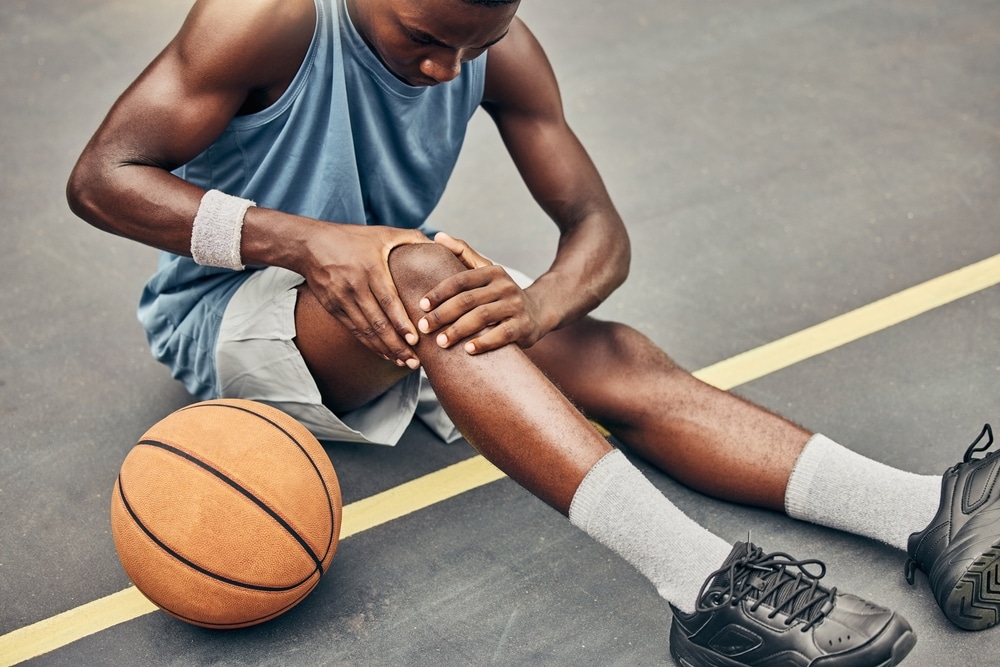
    How can we gradually strengthen the leg after a knee injury or knee surgery?

    The following exercises come from an earlier Basket Clinic rehabilitation program and focus primarily on:

    • controlled knee loading,
    • balance,
    • single-leg stability,
    • lower-limb strength,
    • coordination,
    • and gradual restoration of movement.

    Important: Rehabilitation after a knee injury or surgery must be individualized. The appropriate exercises and timing depend on the exact injury, surgical procedure and stage of recovery. These exercises should therefore be considered an archival training resource rather than a substitute for guidance from a doctor or physiotherapist.

    Knee Exercises

    1. Forward Lunge Position with Controlled Hold

    Step forward into a lunge position with the recovering leg.

    Keep the other leg controlled and gradually transfer the work toward the recovering side.

    Hold the position for approximately 4–5 seconds, then return to the starting position.

    The movement should remain controlled throughout.

    2. Heel Raise in a Lunge Position

    Take a lunge stance with the recovering leg in front and the other leg behind.

    Raise the heel of the front foot.

    Hold for approximately 4–5 seconds, then slowly lower it.

    3. Small Steps Forward

    Begin in a lunge position with the recovering leg in front.

    Using small steps, bring the other foot toward the recovering leg while keeping both knees flexed.

    Then return gradually to the original position.

    4. Small Cross-Steps Behind

    Maintain the same starting position.

    Use the other leg to make small crossing steps behind the recovering leg.

    Return gradually to the starting position.

    5. Step Together and Back

    Start with the recovering leg in front.

    Bring the other foot forward beside it while keeping both knees flexed.

    Then step back into the original position.

    6. Cross-Step Behind

    From the same lunge position, step the non-injured leg behind the recovering leg.

    Return to the starting position.

    The emphasis is on balance and controlled movement.

    7. Single-Leg Balance

    Begin with the recovering leg in front.

    Lift the opposite leg from the floor while maintaining the recovering knee in a flexed position.

    Hold the balance before returning the foot to the ground.

    8. Single-Leg Balance with Knee Extension

    Lift the opposite leg while gradually extending the recovering knee.

    Return slowly and under control.

    9. Single-Leg Flexion and Extension

    Lift the opposite foot from the floor.

    Balance on the recovering leg.

    From this position:

    • extend the recovering knee,
    • flex it again,
    • then place the opposite leg back on the floor.

    10. Trunk Rotation in a Lunge Position

    Hold a stable lunge position with the recovering leg forward.

    Place both hands behind the head.

    Slowly rotate the trunk:

    • to the right,
    • then to the left.

    The lower body should remain controlled.

    11. Small Knee Pulses

    Maintain the lunge position.

    Perform small, controlled up-and-down movements through the recovering knee.

    Avoid uncontrolled bouncing.

    Wide-Stance Exercises

    The next group of exercises begins from a wide stance.

    Both feet are turned slightly outward.

    The knees should track in the same direction as the toes and remain appropriately aligned with the ankles.

    12. Wide-Stance Squat

    Stand with the feet wide apart.

    Bend both knees into a controlled squat, then return upward.

    Maintain knee alignment throughout the movement.

    13. Alternating Side Loading

    From the wide stance:

    • bend the recovering knee while keeping the opposite leg straighter,
    • return to the middle,
    • then repeat toward the other side.

    The goal is to progressively transfer body weight from one side to the other.

    14. Heel Raises and Knee Bends

    Remain in the wide stance with both knees flexed.

    Perform:

    • two heel raises,
    • two slow knee-bending movements,
    • then repeat the heel raises.

    Maintain the same controlled lower-body position throughout.

    15. Step Together from a Wide Stance

    From the wide, flexed-knee position:

    • bring the right foot toward the left,
    • keep both knees flexed,
    • return to the wide stance.

    Repeat on the opposite side.

    16. Step Together with a Squat

    Bring one foot toward the other while maintaining knee flexion.

    Perform a controlled squat.

    Rise without completely locking the knees, then step back into the wide stance.

    Repeat on both sides.

    17. Single-Leg Hold to the Front

    From the wide stance, transfer the weight onto one leg.

    Lift the opposite leg and hold it slightly forward for approximately 4–5 seconds.

    Return to the wide stance.

    Repeat on the other side.

    18. Single-Leg Hold Behind

    Again transfer the weight to one leg.

    Lift the opposite leg and hold it slightly behind and across the body for approximately 4–5 seconds.

    Return to the starting position.

    Repeat on both sides.

    19. Toe-Raise Walk-In

    Begin in the wide stance with the knees flexed.

    Rise onto the toes.

    Using small steps:

    • bring the feet toward each other,
    • maintain knee flexion,
    • lower the heels in the middle,
    • rise onto the toes again,
    • and step back into the wide stance.

    Then lower both heels.

    20. Heel Raises, Step-In and Squat

    From the wide stance:

    1. perform two heel raises,
    2. use small steps to bring the feet together,
    3. perform a controlled squat,
    4. rise again without fully locking the knees,
    5. step back into the wide stance.

    21. Alternating Side Heel Raises

    From the wide stance:

    • extend the left knee while keeping the right knee flexed,
    • perform two heel raises on the right side,
    • return to the central position with both knees flexed,
    • perform two heel raises,
    • then repeat the sequence on the opposite side.

    Quality Before Quantity

    After a knee injury or surgery, the objective is not simply to complete as many repetitions as possible.

    Movement quality matters.

    The athlete should pay attention to:

    • balance,
    • knee alignment,
    • controlled flexion and extension,
    • stability,
    • gradual weight transfer,
    • and symmetrical movement whenever appropriate.

    Progression should be gradual.

    Basketball eventually demands much more than basic strength.

    The player must ultimately regain the ability to:

    • run,
    • stop,
    • change direction,
    • jump,
    • land,
    • defend,
    • and tolerate repeated basketball-specific loading.

    These exercises represent only one stage of that process.

    The goal is not simply to make the knee stronger.

    The goal is to rebuild the movement capacity required for a safe return to basketball.
  • Ice Age in Practice: Managing Sports Injuries

    Ice Age in Practice: Managing Sports Injuries

    This article looks at the basic principles behind sports injuries, the healing process and the traditional use of rest, ice, compression and elevation.

    Important: This is an archival educational resource. Sports injuries vary greatly in type and severity, and significant or persistent injuries should be assessed by an appropriately qualified healthcare professional.

    Types of Injury

    Sports injuries can broadly be divided into two groups.

    Injuries Caused by Internal Forces

    These may result from sudden or repeated forces generated within the body.

    Examples include:

    • muscle strains,
    • muscle tears,
    • overuse injuries,
    • stress-related injuries,
    • and changes caused by repeated loading.

    Some develop suddenly.

    Others appear gradually as repeated stress exceeds the ability of the tissue to recover.

    External or Traumatic Injuries

    These occur when the body is exposed to an external force.

    Examples include:

    • collisions,
    • falls,
    • direct blows,
    • bruises,
    • fractures,
    • and dislocations.

    External stresses can also contribute to smaller repetitive problems such as blisters.

    What Happens After a Soft-Tissue Injury?

    When soft tissue is injured, some of the affected tissue and small blood vessels may also be damaged.

    The amount of bleeding and swelling depends on:

    • the type of tissue involved,
    • the severity of the injury,
    • and the circulation within the injured area.

    The body then begins a complex healing response.

    The Stages of Healing

    It is impossible to predict an exact recovery time for every injury.

    Recovery is influenced by factors such as:

    • severity,
    • age,
    • tissue involved,
    • general physical condition,
    • rehabilitation,
    • and the way the injury is managed.

    The original framework divides healing into three overlapping phases.

    1. Acute or Inflammatory Phase

    This begins immediately after injury and continues for the first several days.

    2. Repair Phase

    This begins relatively early after injury and may continue for several weeks.

    3. Remodeling Phase

    This develops later in the recovery process and may continue for many months.

    These phases are not completely separate.

    They overlap as the body moves from the initial response toward repair and eventually toward stronger, more functional tissue.

    The Acute Phase

    The first stage begins immediately following injury.

    Typical signs may include:

    • pain,
    • warmth,
    • redness,
    • swelling,
    • and loss of normal function.

    Bleeding into damaged tissues may contribute to swelling and sometimes visible discoloration.

    The body responds rapidly to the injury.

    Blood vessels, inflammatory cells and damaged tissues all participate in the early healing process.

    Inflammation is therefore not simply an unwanted event.

    It is part of the body’s response to tissue damage.

    During this period, however, the injured area may be vulnerable to further stress.

    Early Tissue Repair

    As the healing response progresses, an early structural framework begins to form across the damaged tissue.

    Initially this new material is relatively weak.

    This is one reason why excessive stress immediately after an injury may interfere with recovery.

    Muscle spasm can also occur as part of the body’s protective response.

    Although this may restrict movement around the injured area, it can also contribute to discomfort.

    The early management of an injury therefore aims to protect the damaged area and avoid unnecessary additional trauma.

    Traditional Management During the Acute Phase

    The original article uses the classic principles of:

    • Rest
    • Ice
    • Compression
    • Elevation

    These principles have traditionally been used to help manage pain and swelling following acute soft-tissue injury.

    Rest

    Immediately after an injury, stop the activity that caused or aggravated the problem.

    The injured area should be protected from further unnecessary stress.

    Rest, however, does not necessarily mean complete inactivity for the entire body.

    Depending on the injury and professional advice, an athlete may sometimes continue appropriate training for unaffected parts of the body.

    The objective is to protect the injury without losing all physical conditioning unnecessarily.

    Ice

    Cold treatment has traditionally been used after acute injuries, particularly to help manage pain.

    If ice is used:

    • do not place it directly against the skin,
    • wrap the cold pack in a suitable cloth,
    • avoid excessive exposure,
    • and stop if the skin reacts abnormally or the treatment becomes painful.

    Reduced pain after cooling should not be interpreted as proof that the athlete is ready to return immediately to activity.

    Pain relief and tissue recovery are not the same thing.

    When Extra Caution Is Needed with Ice

    Cold treatment should be used carefully.

    Particular caution is appropriate when:

    • sensation in the area is reduced,
    • circulation is impaired,
    • the athlete has an unusual reaction to cold,
    • or there is uncertainty about the nature of the injury.

    When in doubt, seek professional medical advice.

    Compression

    A supportive compression bandage has traditionally been used to help control swelling.

    Compression should be firm but never so tight that it interferes with circulation.

    If the athlete experiences:

    • numbness,
    • tingling,
    • unusual discoloration,
    • increasing pain,
    • or loss of sensation,

    the bandage should be reassessed immediately.

    Elevation

    Elevating an injured limb may also help manage swelling.

    The injured area should be comfortably supported rather than placed in a position that creates additional pain or tension.

    First Aid Matters

    Early decisions after an injury may influence the recovery process.

    The first priority is always safety.

    If the athlete remains in danger, move them away from that danger when it is safe to do so.

    More serious injuries require appropriate medical assessment.

    Coaches should understand the limits of their own role.

    The job of the coach is not to diagnose every injury.

    The job is to recognize when a player needs professional care.

    The Repair Phase

    As the initial inflammatory response settles, the body begins repairing the damaged tissue.

    New connective tissue develops and gradually becomes stronger.

    However, newly repaired tissue does not immediately possess the same strength or function as healthy tissue.

    For this reason, rehabilitation must progress gradually.

    Too little loading may fail to prepare the tissue for sport.

    Too much loading too early may aggravate the injury.

    The challenge is finding the appropriate progression.

    Returning to Movement

    During the repair phase, carefully selected movement can gradually become part of rehabilitation.

    The objective is eventually to restore:

    • range of motion,
    • strength,
    • coordination,
    • flexibility,
    • and sport-specific function.

    Progression should be controlled.

    Pain or significant worsening of symptoms should not simply be ignored.

    The athlete must gradually earn the ability to perform increasingly demanding tasks.

    Returning to Basketball

    Feeling better is not the same as being ready to compete.

    Basketball requires much more than pain-free walking.

    A returning player may need to tolerate:

    • running,
    • acceleration,
    • deceleration,
    • jumping,
    • landing,
    • cutting,
    • contact,
    • defensive movement,
    • repeated high-intensity efforts,
    • and basketball-specific decision-making.

    The final objective is therefore not simply the disappearance of pain.

    It is the restoration of the physical and functional ability required to play basketball safely and effectively.

    The Coach’s Responsibility

    Coaches should understand basic injury-management principles.

    But they should also understand when responsibility must pass to medical and rehabilitation professionals.

    A player should not return simply because:

    • an important game is approaching,
    • the team needs them,
    • the pain temporarily disappears,
    • or the athlete insists that everything is fine.

    The long-term health of the player must remain more important than one practice or one game.

    Ice, compression and elevation may be tools.

    But the most important tool is good judgment.