
Címke: NB I/A

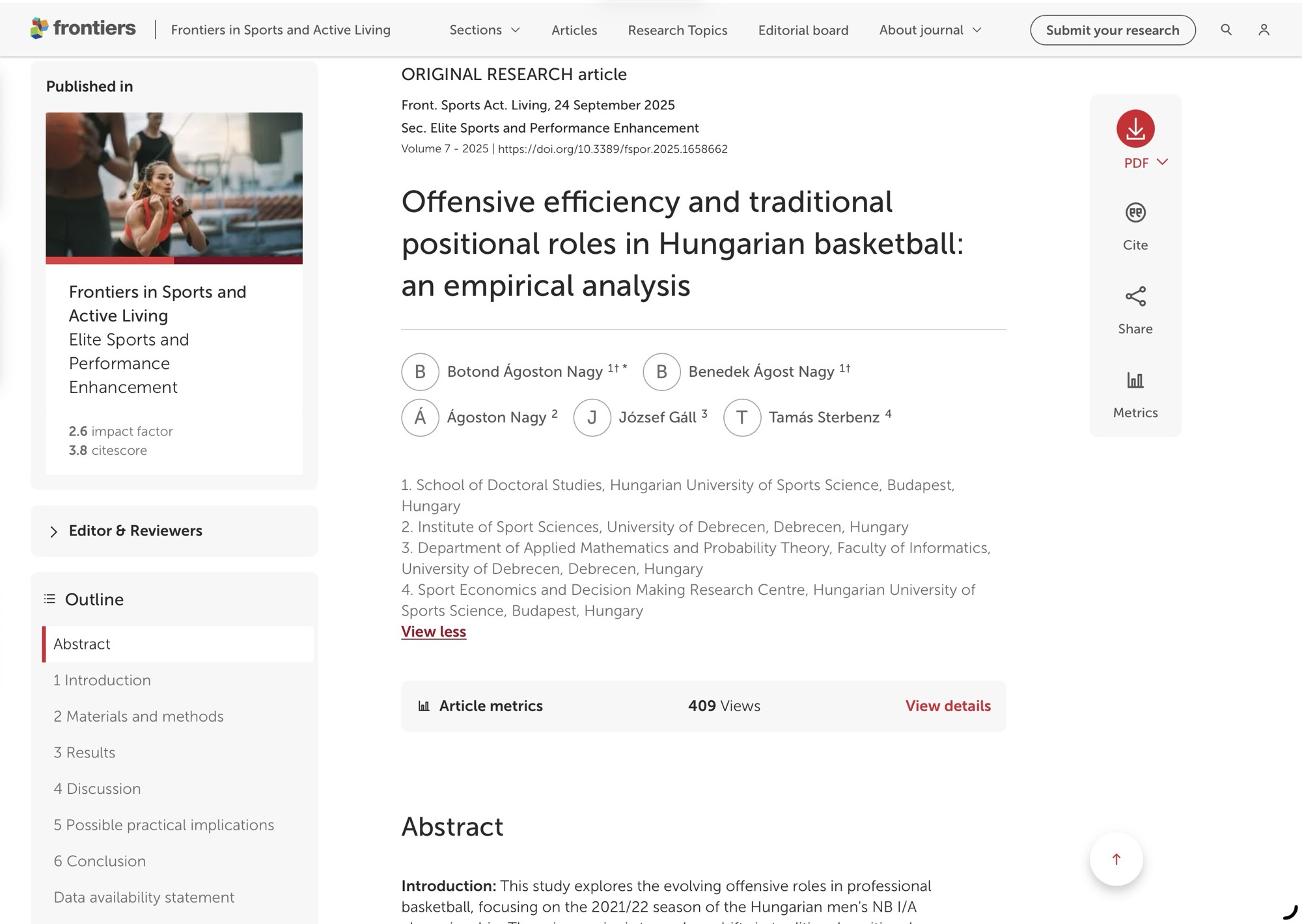
  • New Publication: Offensive Efficiency and Traditional Positional Roles in Hungarian Basketball

    New Publication: Offensive Efficiency and Traditional Positional Roles in Hungarian Basketball

    I am delighted to announce the publication of our latest scientific article in Frontiers in Sports and Active Living, written in collaboration with my co-authors, Benedek Ágost Nagy, Ágoston Nagy, József Gáll, and Tamás Sterbenz.

    📄 Title:

    “Offensive Efficiency and Traditional Positional Roles in Hungarian Basketball: An Empirical Analysis”

    🔗 Full article available here: Frontiers – Article link

    About the study

    This research explores the evolving offensive roles in professional basketball, focusing on the 2021/22 Hungarian NB I/A season. We analyzed 239 player profiles, grouped into imports, Hungarian-educated, and U23 players, using 17 offensive efficiency indicators (points, shooting percentages, usage, OffRtg, NetRtg, assist-to-turnover ratio, etc.).

    Key findings

    Inside positions excelled: Centers and power forwards (positions 4–5) showed higher shooting efficiency compared to perimeter positions. Imports led the way: Foreign players consistently outperformed in scoring, efficiency, and usage. Domestic contributions: Hungarian and U23 players took on important decision-making roles (assists, steals vs. turnovers), showing developmental potential. Youth challenges: U23 players produced lower efficiency but gained valuable experience thanks to mandatory playing time.

    Why it matters

    The study highlights the ongoing transformation of basketball roles beyond the rigid five traditional positions. For Hungarian basketball, the results underline the importance of investing in talent identification and development, ensuring that domestic players are not only present but effective contributors in key offensive situations.

    By focusing on flexible roles, efficient scoring, and decision-making, Hungarian teams can improve both competitiveness and sustainability at the professional level.
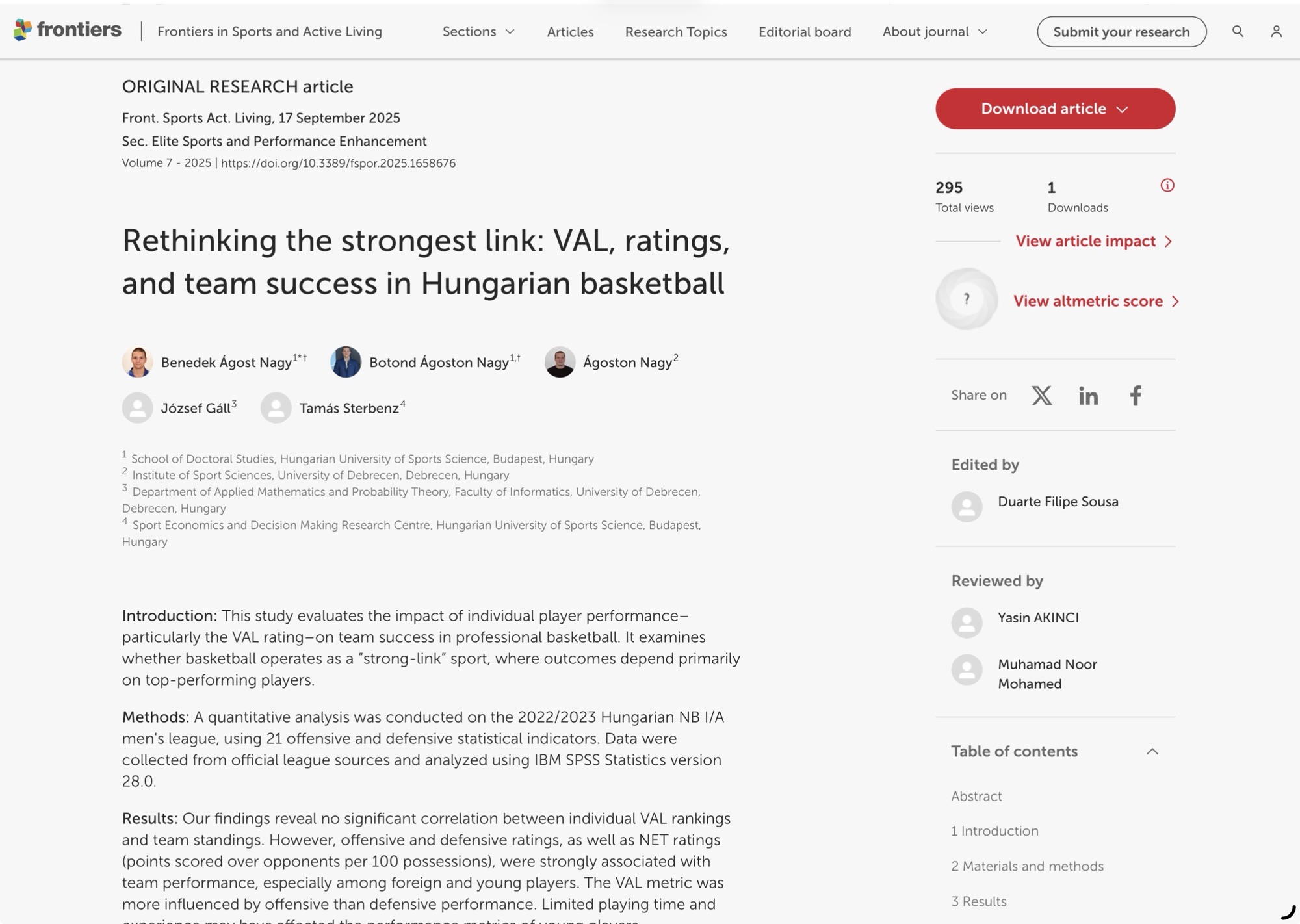
  • New Publication: Rethinking the Strongest Link

    New Publication: Rethinking the Strongest Link

    I am delighted to announce the publication of our latest scientific article in Frontiers in Sports and Active Living, written in collaboration with my co-authors, Benedek Ágost Nagy, Ágoston Nagy, József Gáll and Tamás Sterbenz.

    📄 Title:

    “Rethinking the Strongest Link: VAL, Ratings, and Team Success in Hungarian Basketball”

    🔗 Full text available here: Frontiers – Article link

    About the study

    The research explores whether Hungarian basketball truly operates as a “strong-link” sport, where outcomes depend on top performers, and how well traditional metrics like VAL capture a player’s real impact on team success. Using detailed data from the 2022/23 NB I/A season, we examined 137 players across three categories: imports, Hungarian-educated, and U23 players.

    We analyzed 21 offensive and defensive indicators (including points, shooting percentages, rebounds, assists, turnovers, and advanced ratings like OffRtg, DefRtg, and NetRtg) to understand which measures are most strongly linked to team results.

    Key findings

    VAL is limited: It does not strongly correlate with team standings, and it reflects offensive contributions more than defensive ones. Ratings matter more: Offensive Rating, Defensive Rating, and especially Net Rating showed strong associations with team success. Group differences: Foreign players had the highest performance values, Hungarians were the most balanced, while youth players showed the widest variability. Trends: Mid-range shots continue to decline, while free throws, close-range, and three-point shooting efficiency remain decisive. Practical insight: Coaches should focus on free-throw accuracy, defensive rebounding (especially for youth), and balanced player development rather than relying solely on MVP-type performances.

    Why this matters

    The study demonstrates that team balance and efficiency metrics are more reliable indicators of success than individual star-value rankings. This has significant implications for coaches, player development, and roster building in Hungarian basketball and beyond.

    This publication is an important milestone in my doctoral research, advancing both the academic study of basketball and the visibility of Hungarian basketball on the international stage.