
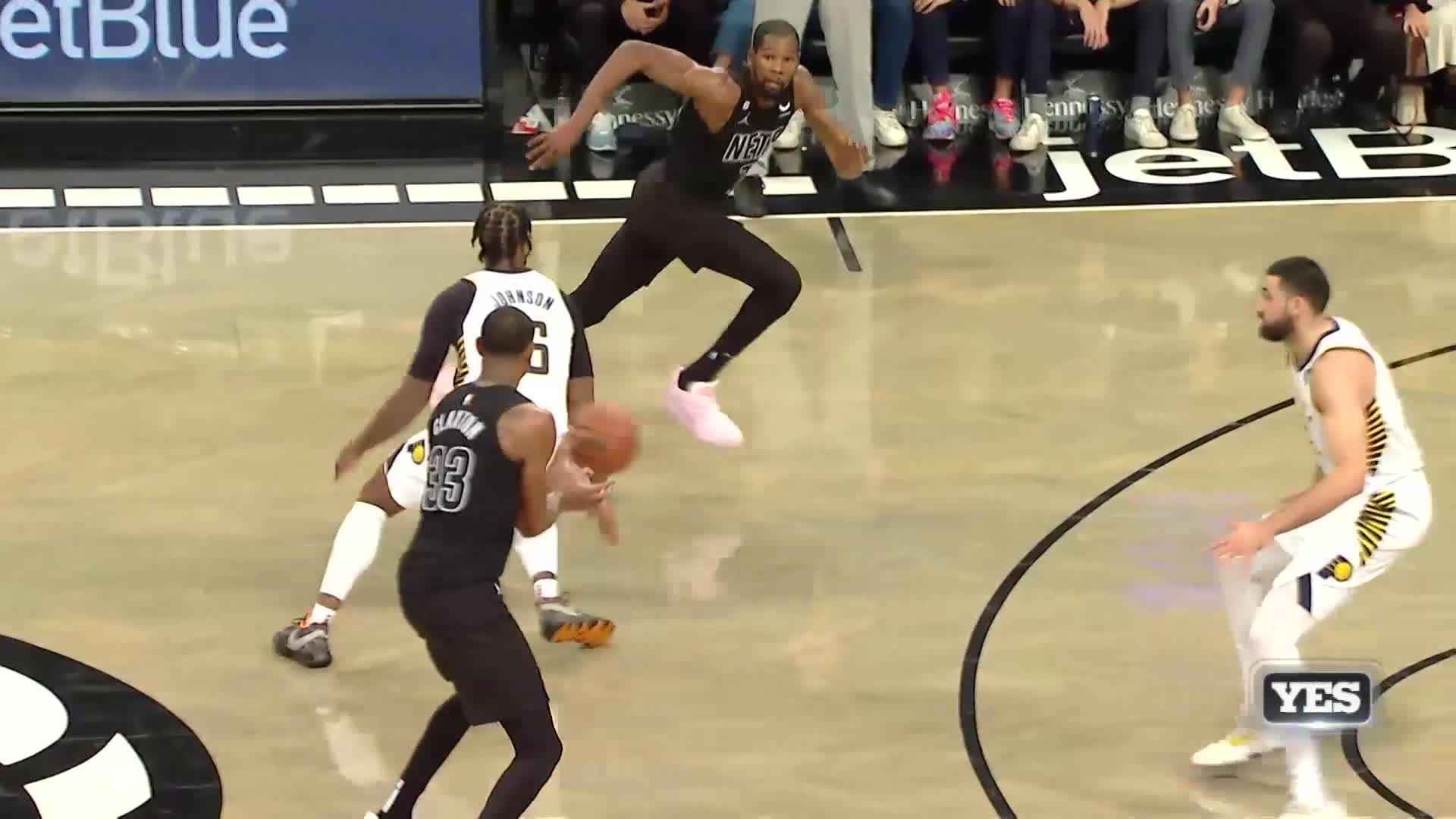
The technique of cutting and getting open is one of the most underrated areas of teaching in youth basketball.
Many coaches spend relatively little time teaching these movements, assuming that players will naturally learn how to get open as they gain experience.
But there is much more to it.
Good cutting technique allows players to create separation from defenders throughout a game.
Players need to learn how to get open.
They cannot always rely on screens to receive the ball. Sometimes they must create separation in an isolated situation simply by reading the defender and using the correct footwork, timing and change of direction.
Some players become masters of this skill.
They read the defense, manipulate the defender and then use the appropriate cut to create space.
The following are ten of the most common cutting techniques.
1. Backdoor Cut
The backdoor cut is used when the defender aggressively denies the passing lane.
When the defender moves between the offensive player and the ball, space opens behind the defense.
That space can be attacked.
The greatest challenge with the backdoor cut is that it requires an accurate, well-timed pass to create a clean finishing opportunity.
At younger levels, this action may lead to turnovers when the timing or passing ability is not yet developed.
The backdoor cut is most effective when the offensive player first encourages the defender to move farther into the passing lane.
Then:
- sell the movement toward the ball,
- change direction sharply,
- explode behind the defender,
- cut toward the basket.
The defender’s aggression becomes the source of the offensive advantage.
2. V-Cut
The V-cut is one of the most common techniques for getting open on the perimeter.
The offensive player first moves inside the three-point line toward the defender.
The player should get close enough to threaten the defender’s space.
Then:
- plant the inside foot,
- change direction explosively,
- sprint back toward the perimeter,
- present a clear target for the pass.
The path creates the shape of a “V.”
The effectiveness comes from the sudden change of direction and speed.
3. L-Cut
The L-cut is particularly useful when a player begins near the low block and wants to get open on the wing.
The movement requires:
- quickness,
- effective footwork,
- and strong body positioning.
Bring the defender upward with you.
Use the inside foot to gain positional advantage and create brief body contact or separation.
Then change direction sharply and sprint toward the wing to receive the pass.
The route resembles the shape of the letter “L.”
4. Curl Cut
The curl cut is used around a screen.
The cutter must read the defender.
When the defender follows closely behind the offensive player through the screen, the cutter can curl tightly around the screener toward the basket.
If executed well, the movement can lead directly to a layup.
The closer the defender trails, the more effective the curl can become.
However, if the defender anticipates the action and goes over the top of the screen into the passing lane, the offensive player should consider another option — particularly the flare cut.
5. Flare Cut
The flare cut and curl cut are closely connected.
The correct choice depends on how the defender plays the screen.
When the defender moves over the top and attempts to take away the passing lane toward the ball, the offensive player should move away from the ball rather than toward it.
The cutter fades toward open perimeter space, often toward the corner or wing.
This creates greater distance between the offensive player and the defender.
The principle is simple:
Curl when the defender trails. Flare when the defender goes over.
6. Baseline Cut
In this action, the offensive player runs underneath the other players along the baseline from one side of the court to the other.
It can be particularly effective against zone defense.
Defenders may become occupied with:
- the basketball,
- another offensive player,
- or their designated zone responsibility.
The cutter can then move behind the defense and appear in an area that is difficult to see.
The baseline cut works best when the movement occurs outside the defenders’ field of vision.
7. UCLA Cut
The UCLA cut became closely associated with the UCLA teams coached by John Wooden.
A common setup begins with a player positioned around the elbow.
The guard passes the ball to the wing.
After making the pass, the guard cuts toward the basket using the elbow player’s screen.
When the timing and spacing are correct, the action can create a direct path to the rim and an open layup.
It is a classic example of combining:
- passing,
- screening,
- and immediate movement toward the basket.
8. Ball-Side Cut
This is a cut toward the ball.
The offensive player will often begin by faking in the opposite direction.
For example:
- make a movement away from the ball,
- cause the defender to shift backward or away,
- plant,
- then cut explosively toward the ball.
The initial fake creates the separation.
The final movement allows the offensive player to receive the pass.
9. Cut Under the Ball Handler
This movement is often used during an exchange with the dribbler.
The off-ball player cuts underneath or behind the ball handler while the ball handler dribbles toward the area the cutter has just left.
The movement can:
- occupy the cutter’s defender,
- create space for the dribbler,
- improve spacing,
- and generate a possible receiving opportunity on the opposite side.
The two players effectively exchange positions.
10. Flash from the Low Post
This is a quick, explosive movement from the low-post area toward the middle of the floor, often into the high-post or free-throw-line area.
The player should not drift slowly into position.
The movement should be sharp and decisive.
A well-timed flash can:
- create a passing target,
- move the defense,
- open space behind the cutter,
- and connect the inside and perimeter areas of the offense.
Cutting Is About Reading the Defense
Cuts should not be memorized as isolated routes.
The most important skill is recognizing why a particular cut is available.
For example:
- denial can create the backdoor cut,
- trailing defense can create the curl,
- overplaying the screen can create the flare,
- poor weak-side vision can create the baseline cut.
The defense provides information.
The offensive player must recognize it.
Move the Defender First
Effective cutting often begins before the real movement.
Players should learn to:
- change speed,
- change direction,
- use body contact legally,
- fake one way before cutting another,
- and manipulate the defender’s positioning.
Simply running toward open space is usually easier to defend.
Creating a reaction first makes the eventual cut far more effective.
Timing Matters
Even the correct cut can fail when the timing is poor.
The cutter must coordinate movement with:
- the passer,
- the screen,
- the position of the ball,
- and the defender’s attention.
Too early, and the passing window may not exist.
Too late, and the defender may recover.
Good cutting requires both technical execution and tactical awareness.
Teach Players How to Get Open
Youth players should not be expected to discover all of these solutions by accident.
Cutting deserves deliberate teaching.
Players need to understand:
- when to cut,
- where to cut,
- how to create separation,
- how to read the defender,
- and how their movement affects teammates.
A player who knows how to move without the ball becomes much more difficult to defend.
And a team filled with players who understand cutting can create scoring opportunities without relying only on dribbling or set plays.
Source: Basketball for Coaches — Cutting in Basketball
Hungarian translation: Dr. Ágoston Nagy
Original Basket Clinic publication date: March 31, 2020