
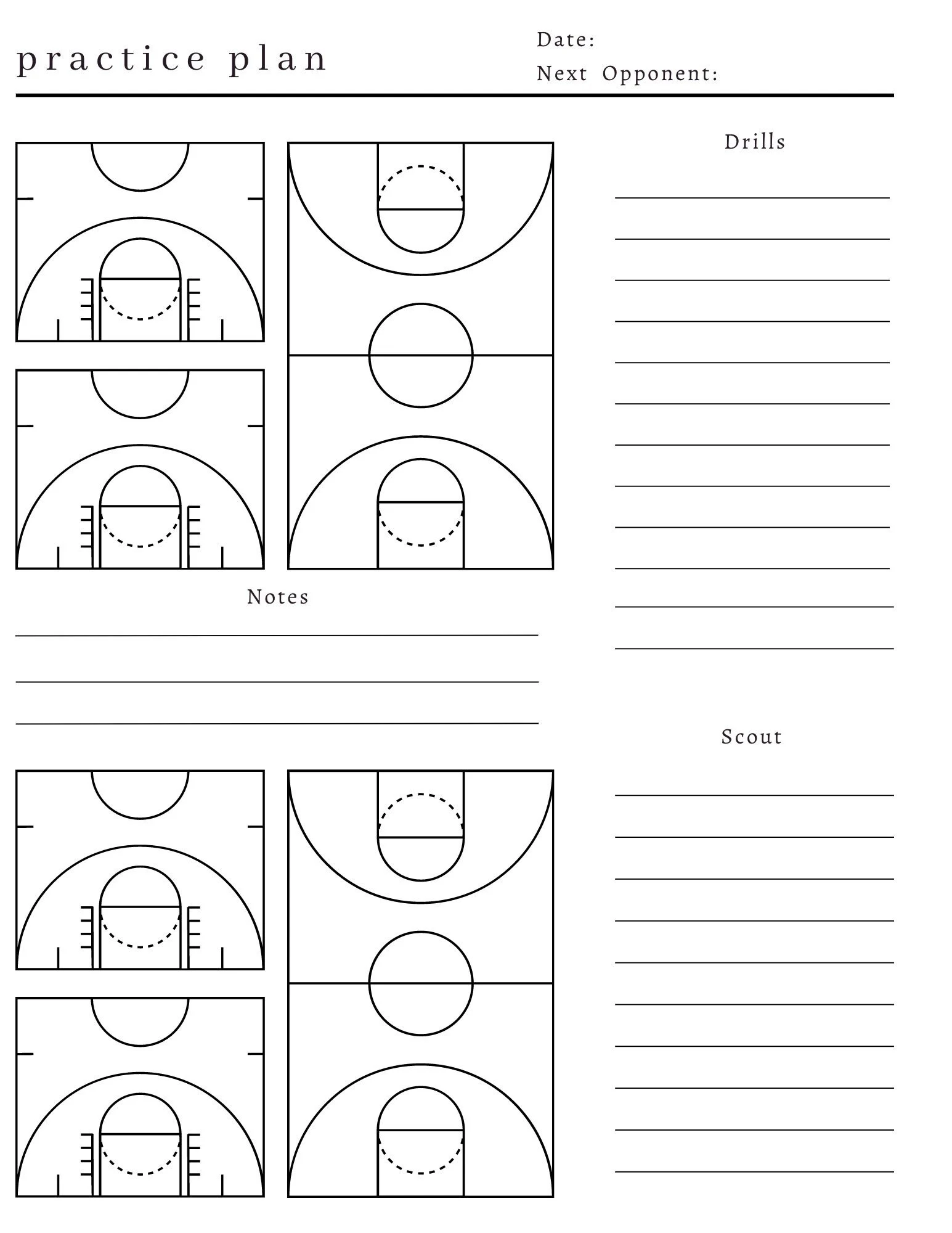
Organizing Practice
One of the most important responsibilities of a coach is organizing and planning practice.
The method used to structure training has a major influence on the successful development of the team.
A good plan gives direction to the work.
At the same time, it must remain flexible enough to respond to what actually happens on the court.
From the Curriculum to the Daily Practice Plan
A useful planning process can be built in three stages:
- Develop the overall curriculum or long-term training plan.
- Use that plan to create the weekly practice schedule.
- From the weekly schedule, prepare the individual daily practice plans.
The daily plan should therefore never exist in isolation.
Each practice should be part of a larger developmental process.
Developing the Daily Plan
1. Calculate the Number of Practices Available
First, determine how many practices are available before the first game.
Every planned day without practice should also be identified, together with the reason for the break.
This gives the coach a realistic picture of the time available.
2. Calculate the Total Training Time
Multiply the total number of practices by the expected duration of each session.
For example, if practices last 1.5 hours, the total number of practices multiplied by 90 minutes gives the total amount of available training time.
This step is important because coaches often overestimate how much can realistically be taught before competition begins.
Time is limited.
Planning must therefore involve priorities.
3. Divide the Available Time Among the Main Phases
The total training time should then be distributed among the different phases of the curriculum.
This provides an approximate amount of time available for each area.
Not every topic deserves the same amount of attention.
Some elements will be more important than others.
For that reason, time may sometimes need to be taken from one phase and reassigned to another.
The important point is that these decisions should be deliberate.
Plan the Period Leading to the Next Game
Use a planning sheet covering the period between the first practice and the next competition.
Mark all days without practice.
At the top of each daily plan, write the main objective of the session.
This gives the practice a clear identity.
Every drill and activity should then contribute to that objective.
Connect Time and Training Content
The available time and the planned training material must fit together.
Each practice should build upon the previous one.
The next session should continue the developmental process.
This progression should continue until the first game.
Practice planning should therefore not consist of a collection of unrelated drills.
It should resemble a sequence.
Each day has a purpose.
Each day prepares the next one.
Follow the Plan — but Record Every Change
Once the plan has been created, it should be followed.
However, any changes should be recorded.
After each practice — but before the following session — the coach should review what happened and make any necessary adjustments to the next practice plan.
This process should continue until competition begins.
The coach therefore works in a continuous cycle:
plan → practice → evaluate → adjust → practice again
The Plan Is a Guide, Not a Law
Changes should be expected.
A training program should never become excessively rigid.
What happens on the court must remain the most important source of information.
The practice plan is a guide.
It is not a law.
But even when the coach changes the route, the final destination must remain clear.
Every modification should answer the question:
Does this change help us move toward our objective?
Flexibility without direction becomes improvisation.
Structure without flexibility becomes rigidity.
Effective coaching requires both.
Do Not Plan the First Practice After the Game in Advance
The first practice following the opening game should not be completely predetermined.
The game itself should decide what needs greater emphasis next.
The coach cannot know that before evaluating the performance.
Competition provides information that practice cannot always provide.
For example, the game may reveal that the team needs considerably more work against full-court pressure.
Or perhaps defensive transition becomes the priority.
Maybe rebounding, spacing or decision-making becomes the most urgent issue.
The next practice should respond to what the game has shown.
Planning Is a Continuous Process
Good practice planning is not simply writing exercises on a sheet of paper.
It means connecting:
- long-term objectives,
- weekly priorities,
- daily practice goals,
- available training time,
- competition,
- evaluation,
- and continuous adjustment.
The coach needs a plan.
But the coach must also be willing to change it.
The most effective plan is therefore not necessarily the one that is followed exactly.
It is the one that consistently keeps the team moving toward the desired goal.