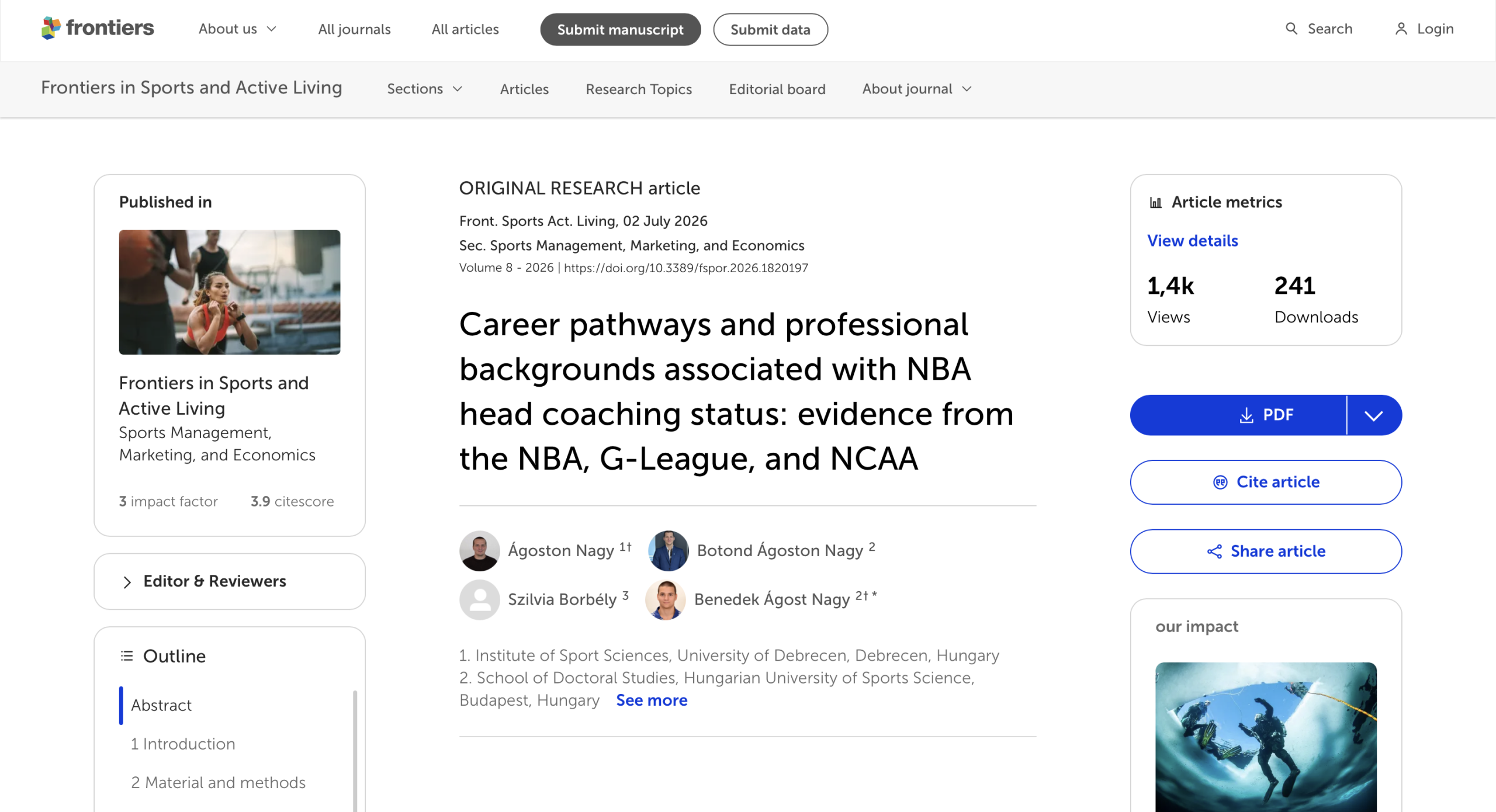
We are pleased to share our new research article published in Frontiers in Sports and Active Living:
Career pathways and professional backgrounds associated with NBA head coaching status: evidence from the NBA, G-League, and NCAA
The study was authored by Ágoston Nagy, Botond Ágoston Nagy, Szilvia Borbély and Benedek Ágost Nagy and examines one of the most interesting questions in professional basketball coaching:
What professional experiences are associated with reaching an NBA head coaching position?
Comparing Three Coaching Environments
The study analyzed the professional backgrounds of 76 head coaches:
- 30 NBA head coaches,
- 30 randomly selected NCAA Division I head coaches,
- and 16 NBA G-League head coaches.
The analysis included demographic characteristics, playing experience and coaching-career variables in order to identify which factors were most strongly associated with NBA head coaching status.
NBA Experience Matters
The clearest result concerned previous experience as an NBA assistant coach.
Among the NBA head coaches in the sample, 83.3% had previously worked as NBA assistant coaches, compared with 37.5% of G-League head coaches and 16.7% of NCAA Division I head coaches.
In the final statistical model, previous NBA assistant coaching experience showed the strongest independent association with NBA head coaching status.
NBA playing experience was also significantly associated with becoming an NBA head coach, although the relationship was weaker than that observed for assistant coaching experience.
Professional Embeddedness Over Demographics
One of the most important messages of the study is that advancement toward an NBA head coaching position appears to be associated more strongly with NBA-specific professional experience and organizational exposure than with demographic characteristics alone.
Age was not a statistically significant predictor in the final model.
The same was true for White race/ethnicity.
Formal educational background also appeared less important than direct professional experience within elite basketball organizations.
Playing Experience Helps — But It Is Not Enough
Having played in the NBA may provide future coaches with valuable experience of:
- elite competition,
- player relationships,
- team dynamics,
- pressure,
- and the organizational demands of professional basketball.
However, the results suggest that playing experience alone does not define the pathway toward becoming an NBA head coach.
The transition into coaching roles — and particularly gaining experience inside an NBA coaching staff — appears to be especially important.
Coaching Careers Are Built Step by Step
There is no single route to the top.
Coaches may begin their professional development as:
- players,
- video analysts,
- player-development coaches,
- assistant coaches,
- G-League coaches,
- or college coaches.
Over time, they accumulate experience through competition, mentoring, professional relationships and different organizational roles.
The results of this study reinforce the idea that elite coaching development is a long-term professional process rather than a single qualification or career event.
Why Does This Matter?
Understanding coaching pathways can help:
- aspiring coaches plan their professional development,
- organizations better understand coaching-career structures,
- coach-education programs identify relevant experiences,
- and researchers explore how elite coaches develop over time.
The findings also suggest that access to professional environments and meaningful coaching roles may be particularly important for career progression.
Importantly, these findings describe associations rather than causal effects. Becoming an NBA assistant coach does not automatically lead to an NBA head coaching position, but within this sample, NBA-specific coaching experience was clearly associated with reaching that level.
Publication Details
Nagy Á, Nagy BÁ, Borbély S and Nagy BÁ (2026).
Career pathways and professional backgrounds associated with NBA head coaching status: evidence from the NBA, G-League, and NCAA.
Frontiers in Sports and Active Living, Volume 8.
DOI: 10.3389/fspor.2026.1820197
Published: July 2, 2026