
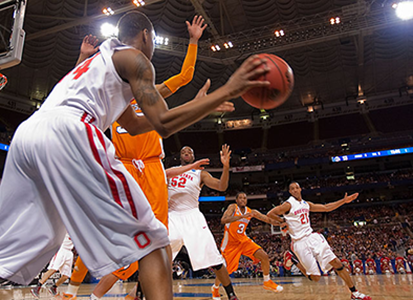
Always be prepared — mentally and physically — for the defense to pressure the ball.
Sometimes the pressure may never come.
But if you are not ready for it, the surprise itself can create poor reactions.
Strong ball handling under pressure begins before the defender attacks.
It begins with preparation.
Face the Defender
When you receive the ball under pressure, turn and face the defender.
Be strong and balanced.
From this position you should be able to:
- pass,
- drive,
- dribble,
- or shoot.
The defender should never be allowed to eliminate all of your options before you have even started the possession.
You Control the Situation — Not the Defender
Basketball is a constant battle for balance.
In many 1-on-1 situations, the first player to lose balance or body position loses the advantage.
When you square up against the defender, practice maintaining a strong base.
Use footwork to attack the defender’s stance.
When possible, step aggressively toward or beyond the defender’s lead foot and force the defender to react.
The important principle is:
Do not allow the defender to dictate your dribble.
You should determine the direction and rhythm of the action.
Protect the Ball with Your Body
Use your body to create a barrier between the defender and the basketball.
Keep the ball strong and protected.
When holding the ball, bring it into a secure position near the body rather than exposing it unnecessarily.
Use pivots to change the angle and prevent the defender from reaching directly toward the ball.
Your body position should make the defender work around you rather than allowing a direct path to the basketball.
Do Not Rush Into the Dribble
Many young players believe that the moment a defender applies pressure, they must immediately begin dribbling.
That is often a mistake.
An aggressive defender usually gives something away.
The defender may:
- overplay one side,
- lean too far forward,
- open a driving lane,
- or become vulnerable to a pass fake.
Take enough time to recognize what the defense has given you.
Then attack it.
Maintain Balance and Body Control
Even a player who is not exceptionally fast can protect the basketball effectively if body control and balance are good.
Speed is useful.
Control is essential.
A player who remains balanced can:
- change direction,
- change pace,
- protect the ball,
- and react to the defender.
A player who loses balance becomes predictable.
Practice Different Speeds and Rhythms
Do not practice every dribble at the same speed.
Work on ball handling while:
- walking,
- moving slowly,
- accelerating,
- decelerating,
- using longer steps,
- using shorter steps.
The objective is to become comfortable changing rhythm.
A defender becomes much more difficult to control when the offensive player never changes speed.
Put the Defender on Their Heels
Use changes of:
- direction,
- speed,
- and rhythm
to force the defender out of balance.
A useful sequence is:
pass fake → read the defender → attack with the dribble
The pass fake may cause the defender to shift weight, turn the head or move the feet.
That moment can create the space needed to attack.
Make the Defender Cross the Feet
One of the objectives of change-of-direction dribbling is to make the defender lose an efficient defensive stance.
If the defender is forced to cross the feet or turn the hips sharply, the offensive player gains an advantage.
Use:
- hesitations,
- changes of pace,
- directional changes,
- and fakes
to create that reaction.
Then accelerate.
Confidence Under Pressure
Do not play afraid of losing the basketball.
Every player will eventually commit a turnover.
Fear of making a mistake often creates the very mistake the player is trying to avoid.
Instead, focus on:
- balance,
- body control,
- ball protection,
- reading the defender,
- and making a deliberate decision.
Confidence does not mean taking unnecessary risks.
It means trusting the skills you have practiced.
Pressure Is an Opportunity
Aggressive defenders want to make you uncomfortable.
But aggressive defense also creates opportunities.
The closer the defender plays, the more important it becomes to recognize:
- where the defender’s weight is,
- which direction is being denied,
- which space has been opened,
- and when to attack.
The goal is not simply to survive pressure.
The goal is to make the defender’s pressure work against them.
Stay balanced.
Protect the ball.
Control the rhythm.
Read the defender.
Then attack the space that becomes available.