
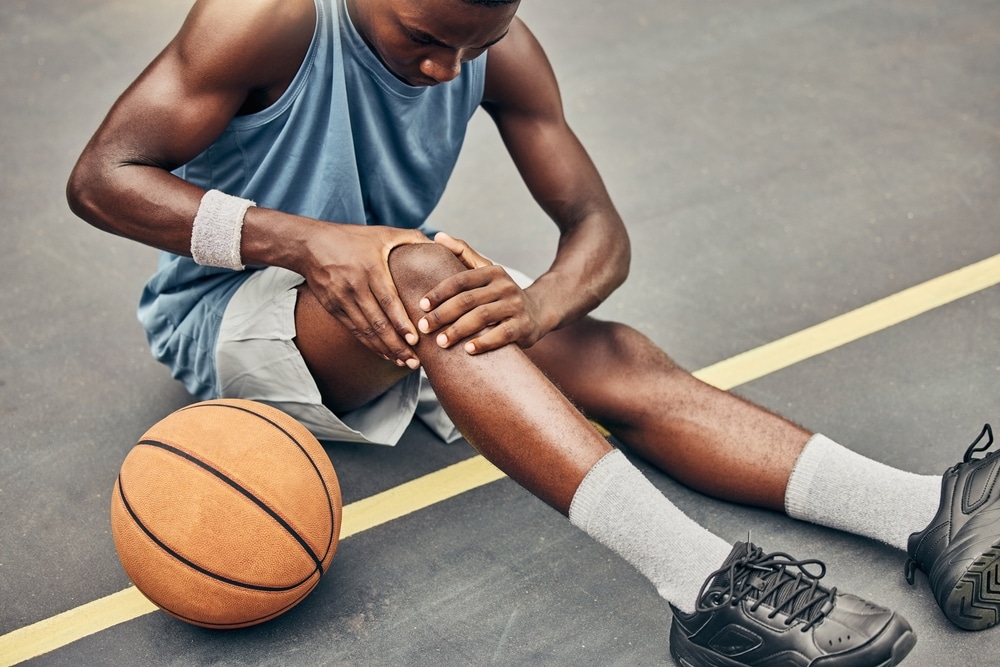
How can we gradually strengthen the leg after a knee injury or knee surgery?
The following exercises come from an earlier Basket Clinic rehabilitation program and focus primarily on:
- controlled knee loading,
- balance,
- single-leg stability,
- lower-limb strength,
- coordination,
- and gradual restoration of movement.
Important: Rehabilitation after a knee injury or surgery must be individualized. The appropriate exercises and timing depend on the exact injury, surgical procedure and stage of recovery. These exercises should therefore be considered an archival training resource rather than a substitute for guidance from a doctor or physiotherapist.
Knee Exercises
1. Forward Lunge Position with Controlled Hold
Step forward into a lunge position with the recovering leg.
Keep the other leg controlled and gradually transfer the work toward the recovering side.
Hold the position for approximately 4–5 seconds, then return to the starting position.
The movement should remain controlled throughout.
2. Heel Raise in a Lunge Position
Take a lunge stance with the recovering leg in front and the other leg behind.
Raise the heel of the front foot.
Hold for approximately 4–5 seconds, then slowly lower it.
3. Small Steps Forward
Begin in a lunge position with the recovering leg in front.
Using small steps, bring the other foot toward the recovering leg while keeping both knees flexed.
Then return gradually to the original position.
4. Small Cross-Steps Behind
Maintain the same starting position.
Use the other leg to make small crossing steps behind the recovering leg.
Return gradually to the starting position.
5. Step Together and Back
Start with the recovering leg in front.
Bring the other foot forward beside it while keeping both knees flexed.
Then step back into the original position.
6. Cross-Step Behind
From the same lunge position, step the non-injured leg behind the recovering leg.
Return to the starting position.
The emphasis is on balance and controlled movement.
7. Single-Leg Balance
Begin with the recovering leg in front.
Lift the opposite leg from the floor while maintaining the recovering knee in a flexed position.
Hold the balance before returning the foot to the ground.
8. Single-Leg Balance with Knee Extension
Lift the opposite leg while gradually extending the recovering knee.
Return slowly and under control.
9. Single-Leg Flexion and Extension
Lift the opposite foot from the floor.
Balance on the recovering leg.
From this position:
- extend the recovering knee,
- flex it again,
- then place the opposite leg back on the floor.
10. Trunk Rotation in a Lunge Position
Hold a stable lunge position with the recovering leg forward.
Place both hands behind the head.
Slowly rotate the trunk:
- to the right,
- then to the left.
The lower body should remain controlled.
11. Small Knee Pulses
Maintain the lunge position.
Perform small, controlled up-and-down movements through the recovering knee.
Avoid uncontrolled bouncing.
Wide-Stance Exercises
The next group of exercises begins from a wide stance.
Both feet are turned slightly outward.
The knees should track in the same direction as the toes and remain appropriately aligned with the ankles.
12. Wide-Stance Squat
Stand with the feet wide apart.
Bend both knees into a controlled squat, then return upward.
Maintain knee alignment throughout the movement.
13. Alternating Side Loading
From the wide stance:
- bend the recovering knee while keeping the opposite leg straighter,
- return to the middle,
- then repeat toward the other side.
The goal is to progressively transfer body weight from one side to the other.
14. Heel Raises and Knee Bends
Remain in the wide stance with both knees flexed.
Perform:
- two heel raises,
- two slow knee-bending movements,
- then repeat the heel raises.
Maintain the same controlled lower-body position throughout.
15. Step Together from a Wide Stance
From the wide, flexed-knee position:
- bring the right foot toward the left,
- keep both knees flexed,
- return to the wide stance.
Repeat on the opposite side.
16. Step Together with a Squat
Bring one foot toward the other while maintaining knee flexion.
Perform a controlled squat.
Rise without completely locking the knees, then step back into the wide stance.
Repeat on both sides.
17. Single-Leg Hold to the Front
From the wide stance, transfer the weight onto one leg.
Lift the opposite leg and hold it slightly forward for approximately 4–5 seconds.
Return to the wide stance.
Repeat on the other side.
18. Single-Leg Hold Behind
Again transfer the weight to one leg.
Lift the opposite leg and hold it slightly behind and across the body for approximately 4–5 seconds.
Return to the starting position.
Repeat on both sides.
19. Toe-Raise Walk-In
Begin in the wide stance with the knees flexed.
Rise onto the toes.
Using small steps:
- bring the feet toward each other,
- maintain knee flexion,
- lower the heels in the middle,
- rise onto the toes again,
- and step back into the wide stance.
Then lower both heels.
20. Heel Raises, Step-In and Squat
From the wide stance:
- perform two heel raises,
- use small steps to bring the feet together,
- perform a controlled squat,
- rise again without fully locking the knees,
- step back into the wide stance.
21. Alternating Side Heel Raises
From the wide stance:
- extend the left knee while keeping the right knee flexed,
- perform two heel raises on the right side,
- return to the central position with both knees flexed,
- perform two heel raises,
- then repeat the sequence on the opposite side.
Quality Before Quantity
After a knee injury or surgery, the objective is not simply to complete as many repetitions as possible.
Movement quality matters.
The athlete should pay attention to:
- balance,
- knee alignment,
- controlled flexion and extension,
- stability,
- gradual weight transfer,
- and symmetrical movement whenever appropriate.
Progression should be gradual.
Basketball eventually demands much more than basic strength.
The player must ultimately regain the ability to:
- run,
- stop,
- change direction,
- jump,
- land,
- defend,
- and tolerate repeated basketball-specific loading.
These exercises represent only one stage of that process.
The goal is not simply to make the knee stronger.
The goal is to rebuild the movement capacity required for a safe return to basketball.